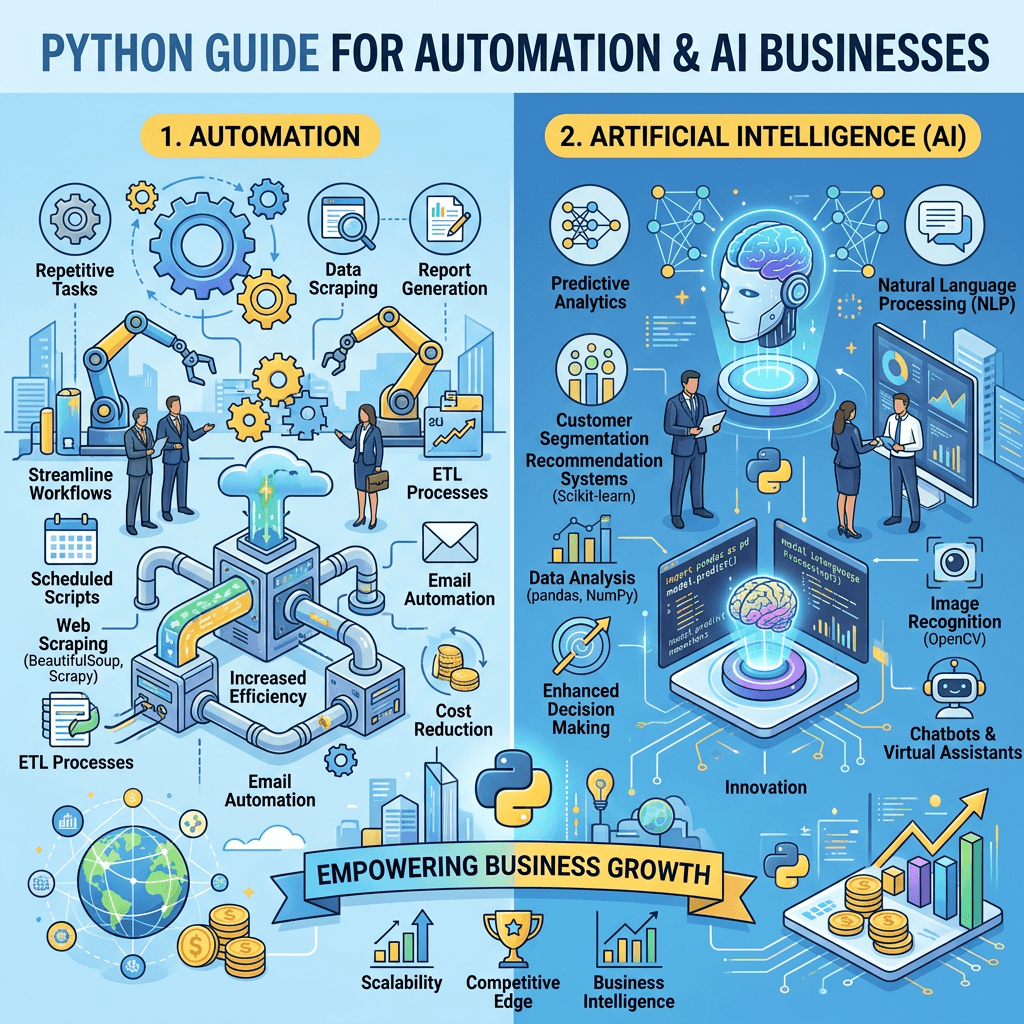
Python Guide: What It Is, What It Does, and Why It Matters in Modern IT
Python is a high-level, open-source programming language known for its readable syntax, flexibility, and wide range of applications. It is used for web development, automation, data analysis, artificial intelligence, machine learning, cybersecurity, and IT administration.
For businesses, Python can automate repetitive tasks, connect different systems, process data, and support applications that would otherwise require significant manual work. Its large ecosystem of libraries and frameworks also makes it possible to build solutions without developing every component from scratch.
This Python guide explains what Python is, how it works, where it is used, and why it has become such an important technology for modern IT and business operations.
What Is Python?
Python is a general-purpose programming language designed to make software development relatively easy to read and write. Unlike lower-level programming languages that require developers to work closely with computer hardware and memory, Python uses a higher-level syntax that allows developers to focus more on solving problems and building applications.
Python was created by Guido van Rossum and first released in 1991. Since then, it has developed into one of the most widely used programming languages, supported by a large global developer community and an extensive collection of libraries and frameworks.
One of Python’s biggest advantages is its readability. A simple Python program can often be understood more easily than equivalent code written in a more complex language. This makes Python useful for both experienced developers and people learning programming for the first time.
Python is also cross-platform. It can run on Windows, macOS, Linux, and many server environments, making it suitable for a wide range of IT infrastructures.
What Is Python Used For?
Python is not limited to one type of software development. Its flexibility allows it to be used across many areas of technology.
Python for Automation
Automation is one of Python’s most practical applications. Businesses and IT teams can use Python scripts to perform repetitive tasks automatically instead of completing them manually.
For example, Python can be used to:
- Rename or organize large numbers of files
- Generate regular reports
- Process spreadsheets and databases
- Monitor systems and servers
- Automate backups
- Move data between applications
- Send automated notifications
- Process large amounts of information
Instead of having an employee repeat the same task every day, a properly designed Python script can perform the process automatically.
This can save time and reduce the possibility of human error, particularly when a business performs the same operation repeatedly.
Python for Artificial Intelligence and Machine Learning
Python has become particularly important in artificial intelligence (AI) and machine learning because of its extensive collection of specialized libraries and frameworks.
Popular Python tools include TensorFlow, PyTorch, scikit-learn, and Pandas. These tools provide developers with functionality for building machine learning models, analyzing datasets, processing information, and developing AI applications.
Python can therefore support applications such as:
- Predictive analytics
- Recommendation systems
- Data classification
- Natural language processing
- Image recognition
- Fraud detection
- Customer behavior analysis
The language itself is only one component of an AI system. Developers also need appropriate data, algorithms, computing resources, and infrastructure. However, Python provides an accessible environment for connecting many of these components.
Python for Data Analysis
Businesses generate large amounts of data through websites, sales systems, customer interactions, financial applications, and other digital platforms.
Python provides tools that allow developers and analysts to collect, clean, transform, analyze, and visualize this information.
Libraries such as Pandas and NumPy are commonly used for data processing and numerical calculations, while visualization libraries can help turn datasets into charts and reports.
For example, a company could use Python to process sales data and identify:
- Monthly revenue trends
- Best-performing products
- Customer purchasing patterns
- Changes in website traffic
- Inventory levels
- Operational performance
This makes Python useful not only for software developers but also for organizations that rely on data to make business decisions.
Python for Web Development
Python can also be used to build websites and web applications.
Popular Python web frameworks include Django and Flask. These frameworks provide developers with tools for building applications without having to create every component from the ground up.
Python-powered web applications can include:
- Business portals
- Customer dashboards
- Content management systems
- Online services
- APIs
- Internal business applications
- Data-driven web platforms
For a business deploying a Python application, the programming language is only part of the infrastructure. The application also needs suitable hosting, server configuration, security, backups, and ongoing maintenance.
Archer IT Solutions provides web hosting services and managed IT services that can support businesses managing websites, servers, and other technology infrastructure.
Python in IT Administration
Python is also useful for IT professionals who manage computers, networks, servers, and cloud infrastructure.
Instead of manually performing repetitive administrative tasks across dozens or hundreds of systems, IT teams can use scripts to automate certain processes.
Examples include:
- Monitoring server activity
- Checking system health
- Managing files and directories
- Automating routine maintenance
- Collecting system information
- Processing log files
- Managing user accounts
- Connecting to APIs
- Automating infrastructure tasks
Python can therefore complement traditional IT administration by making repetitive processes faster and more consistent.
For organizations that depend on reliable infrastructure, automation can become part of a broader technology strategy that includes monitoring, security, backups, and managed IT support.
Python vs Other Programming Languages
Python is not the only programming language available, and it is not automatically the best choice for every project.
| Feature | Python | Java | C++ |
|---|---|---|---|
| Ease of learning | High | Moderate | More difficult |
| Development speed | Fast | Moderate | Often slower |
| Automation | Excellent | Good | Good |
| Data science | Excellent | Good | Good |
| AI and machine learning | Excellent | Good | Good |
| System-level programming | Limited | Limited | Excellent |
| Web development | Strong | Strong | Less common |
| Community and libraries | Very large | Very large | Very large |
The right language depends on the project’s requirements. Python is particularly attractive when readability, rapid development, automation, data processing, or AI capabilities are important.
Why Python Is Popular in Business
Python’s popularity is not only about programming. Businesses can benefit from the ability to automate processes and connect different systems.
For example, imagine a company that receives sales information from an online store and manually creates a weekly report. A Python application could potentially collect the information, process it, calculate the required metrics, and generate the report automatically.
This can reduce repetitive work and allow employees to spend more time on activities that require human judgment.
Python can also connect different business systems through APIs. A company might use Python to move information between an ecommerce platform, a customer relationship management system, a database, and an internal reporting system.
This type of integration can be particularly useful as a business grows and its technology environment becomes more complex.
Is Python Difficult to Learn?
Python is generally considered one of the more beginner-friendly programming languages because its syntax is relatively readable.
However, learning Python is different from simply learning the syntax.
A beginner normally needs to understand concepts such as:
- Variables
- Data types
- Conditional statements
- Loops
- Functions
- Lists and dictionaries
- Classes and objects
- Modules and packages
- Error handling
- File handling
- APIs
After learning these fundamentals, a person can begin applying Python to a specific area such as automation, data analysis, web development, or machine learning.
The difficulty ultimately depends on what someone wants to build. Writing a simple automation script is considerably different from developing a large production application.
Common Python Problems and How to Address Them
Although Python can simplify development and automation, Python applications can still encounter technical problems.
Dependency and compatibility problems
Python applications often rely on external packages. Different projects may require different versions of the same package.
Using virtual environments helps isolate project dependencies and reduce compatibility problems.
Slow Python scripts
Python is not always the fastest choice for computationally intensive tasks. Developers can improve performance by profiling the application, optimizing inefficient code, using appropriate libraries, or moving certain workloads to more suitable technologies.
Security vulnerabilities
Third-party packages can contain security vulnerabilities. Python applications should therefore use trusted dependencies and keep packages updated. Organizations should also monitor dependencies and follow appropriate security practices.
Deployment problems
A Python application that works correctly on a developer’s computer may encounter problems when moved to a production server.
Differences in Python versions, dependencies, environment variables, operating systems, permissions, and server configuration can all cause deployment issues.
Proper testing, documentation, environment management, and server configuration can reduce these problems.
Python and Managed IT Services
Python development and IT infrastructure are closely connected when businesses use Python applications in production.
An application may need:
- A properly configured server
- Secure hosting
- Database connectivity
- Backups
- Monitoring
- Software updates
- Access controls
- Security measures
- Performance monitoring
This is where managed IT services can complement development work.
Archer IT Solutions provides managed IT services, server administration support, and web hosting for businesses that need assistance managing their technology infrastructure.
The goal is not simply to run Python code. A production system also needs to remain secure, available, maintainable, and properly supported.
Python Resources for Beginners
If you want to learn Python, the best place to start is with the official documentation from Python.org.
Other educational resources can help beginners practice concepts through examples and projects. The important thing is to combine learning with practical exercises rather than trying to memorize every Python feature.
A beginner might start with a small project such as:
- Create a simple calculator.
- Write a script that renames files.
- Read information from a CSV file.
- Create an automated report.
- Connect to a simple API.
- Build a small web application.
Practical projects help turn programming concepts into usable skills.
Frequently Asked Questions About Python
What is Python used for?
Python is used for automation, web development, data analysis, artificial intelligence, machine learning, cybersecurity, scripting, and IT administration.
Is Python good for beginners?
Yes. Python’s relatively readable syntax makes it a popular starting point for people learning programming. However, becoming proficient still requires learning programming concepts and practicing regularly.
Can Python automate business tasks?
Yes. Python can automate repetitive processes such as data processing, report generation, file management, system monitoring, and communication between different applications.
Is Python used for artificial intelligence?
Yes. Python is widely used in AI and machine learning because of its extensive ecosystem of libraries and frameworks.
Can Python run on a web server?
Yes. Python applications can run on servers using frameworks and appropriate server infrastructure. The exact configuration depends on the application and hosting environment.
Does a business need IT support for Python?
Not necessarily. A developer can build and maintain a Python application independently. However, businesses running production applications may benefit from IT support for hosting, security, backups, monitoring, server administration, and infrastructure management.
Conclusion
Python has become an important part of modern IT because it combines relatively simple syntax with a powerful ecosystem of tools and libraries. It can automate repetitive work, process data, support web applications, and provide a foundation for AI and machine learning projects.
For businesses, the biggest value of Python is not simply the programming language itself. Its real value comes from what organizations can build and automate with it.
Whether you are exploring Python as a beginner, considering business automation, or already running Python-based applications, understanding how the language fits into your wider IT environment can help you make better technology decisions.
If your business needs help with hosting, servers, website infrastructure, or managed IT support, contact Archer IT Solutions or submit a support ticket.


No responses yet