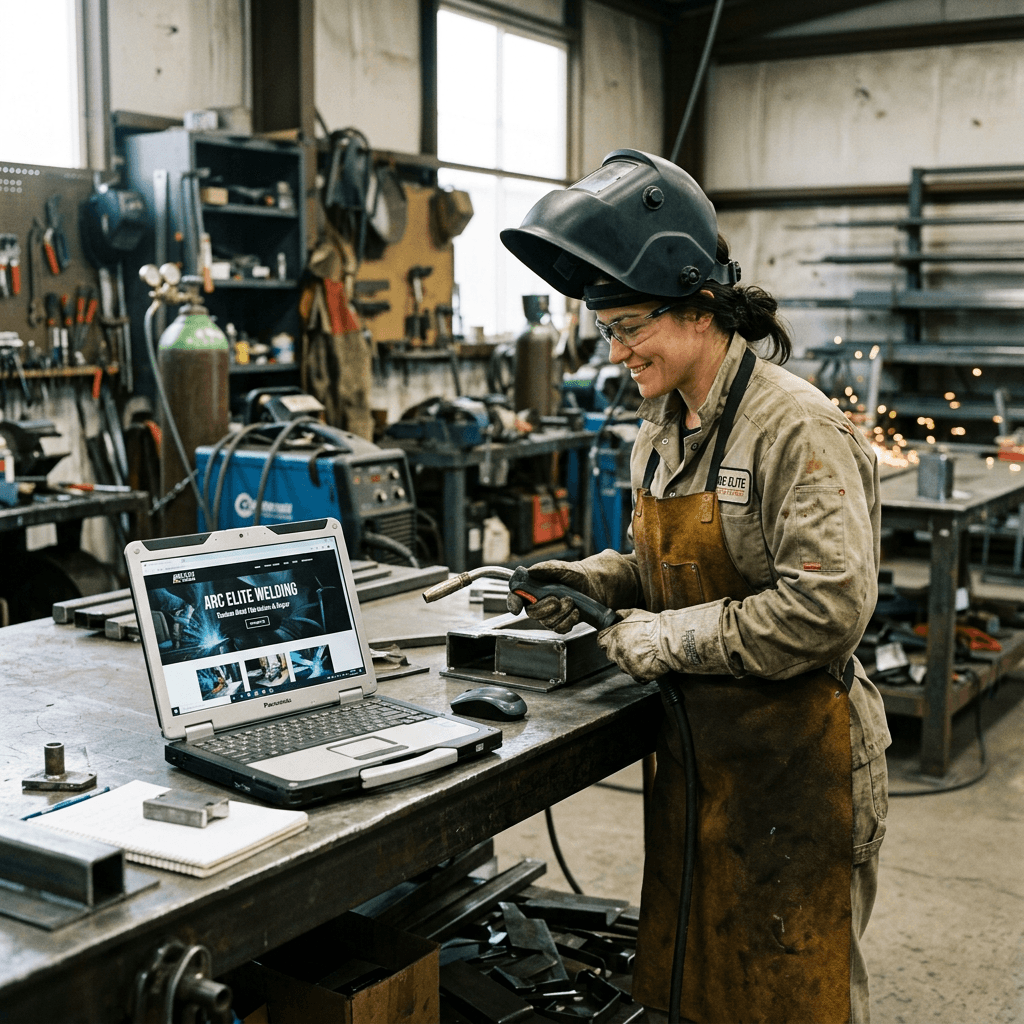
How to Build a High-Converting Welding Business Website
If you run a welding business, your website should do more than provide your phone number and a list of services. It should help potential customers understand what you do, see examples of your work, establish trust, and take the next step toward requesting a quote.
Customers may search for services such as mobile welding, trailer repair, custom fabrication, gate repair, structural welding, or commercial welding. A well-structured website can make it easier for those visitors to find the right service and contact your business.
The original article correctly identifies project photos, service pages, local search visibility, clear contact options, and mobile usability as important elements of a welding business website.
1. Start With a Clear Homepage
Your homepage should quickly answer three questions:
What do you do?
Where do you provide your services?
How can a customer contact you?
A strong homepage can include:
- A clear headline describing your primary welding services
- Your service area
- A prominent phone number
- A “Request a Quote” button
- A short introduction to your business
- Key welding services
- Examples of completed projects
- Customer reviews, where genuine
- Relevant certifications or credentials
- A clear contact option
Avoid making visitors search through several pages to figure out what your business actually does.
2. Create Dedicated Pages for Your Welding Services
One general page titled “Welding Services” may not adequately explain everything your business offers.
Consider creating individual pages for important services, such as:
- Mobile welding
- Custom metal fabrication
- Trailer welding and repair
- Gate and fence welding
- Commercial welding
- Farm equipment repair
- Aluminum welding
- Stainless steel welding
- Structural welding
- Handrail and stair railing fabrication
Dedicated service pages allow you to explain what each service involves, who it is for, the types of projects you handle, and how customers can request an estimate.
They can also help organize your website around the specific services people are searching for. Google recommends creating helpful, descriptive content that makes it easier for users and search engines to understand a page. Google Search Central SEO Starter Guide
Don’t create dozens of nearly identical pages simply by changing the name of a city or service. Each page should provide genuinely useful information.
3. Showcase Your Actual Welding Projects
Welding is a highly visual service.
Potential customers want to see evidence of the type and quality of work you perform. A project gallery can therefore be one of the most useful parts of the website.
Use genuine photographs from completed jobs where you have permission to publish them.
For each project, consider including a short explanation:
- What problem did the customer have?
- What work was performed?
- What materials or techniques were involved?
- What was the finished result?
Before-and-after photographs can be particularly useful for repair projects.
Instead of simply displaying a gallery of unrelated photographs, organize projects by service where appropriate. This makes it easier for a visitor to find work similar to what they need.
4. Make It Easy to Request a Quote
A visitor who needs welding work should not have to search for your contact information.
Include a clear call to action such as:
Request a Quote
or
Call for a Welding Estimate
A quote form can request information such as:
- Name
- Phone number
- Email address
- Location
- Type of welding work required
- Brief description of the project
- Preferred timeframe
- Project photographs, where useful
Photographs can be particularly helpful for welding repairs because they may give the business an initial understanding of the problem before speaking with the customer.
Keep the form reasonably short. Asking for unnecessary information can discourage people from completing it.
5. Make the Website Mobile-Friendly
Many local-service searches happen on smartphones.
A potential customer may be searching for a welder while dealing with damaged equipment, a broken gate, or another urgent repair. If the website is difficult to use on a phone, that visitor may leave before contacting you.
Make sure the mobile version of the website provides:
- Readable text
- Easy-to-tap buttons
- A visible phone number
- Simple navigation
- Fast-loading images
- Usable forms
- Properly displayed project photographs
Test the website on actual smartphones rather than assuming that a desktop version will automatically work well on smaller screens.
6. Clearly Define Your Service Area
Local relevance is particularly important for businesses that provide services at a customer’s location.
Tell visitors where you actually work.
Depending on the business, this might include:
- City
- Towns
- Counties
- Regions
- Nearby communities
For example, a mobile welder could explain the areas covered and whether additional travel is available.
Your service area information should be accurate and written naturally. Avoid creating pages for locations you do not actually serve simply to target additional keywords.
A properly maintained Google Business Profile can also complement your website by helping customers find business information through Google Search and Maps.
7. Build Trust With Real Information
A customer is often choosing a welding contractor without having met them before.
Your website can help reduce uncertainty by providing genuine information about the business.
Useful trust signals may include:
- Years of experience, if accurately stated
- Relevant qualifications
- Certifications
- Insurance information where appropriate
- Professional memberships
- Genuine customer reviews
- Photos of completed work
- Business address or service area
- Information about the team
Do not publish fabricated testimonials, certifications, credentials, or project results. Trust signals work because they provide evidence—not because a page contains a large number of claims.
8. Optimize Your Website for Local SEO
Local SEO helps a business become more discoverable for searches associated with its services and geographic area.
For a welding company, relevant searches might include variations of:
- Mobile welder near me
- Welding services in [city]
- Trailer welding repair
- Gate welding
- Custom metal fabrication
- Commercial welding
Your service pages, homepage, title tags, headings, internal links, and location information should accurately reflect the services you provide.
Google’s documentation also emphasizes making content useful to visitors rather than creating pages primarily for search engines. Google Search Central
9. Keep Your Website Fast
A welding website can easily become image-heavy because photographs are an important part of demonstrating your work.
Large, unoptimized images can make pages slower to load.
Consider:
- Resizing images before uploading them
- Compressing photographs
- Using appropriate image formats
- Avoiding unnecessarily large videos
- Removing unused plugins
- Using appropriate caching and performance tools
- Choosing hosting that can support your website’s requirements
You can use Google PageSpeed Insights to identify potential performance issues on individual pages.
Hosting is also part of the technical foundation. Archer IT Solutions’ web hosting service can be linked naturally here for businesses reviewing their hosting environment.
10. Create a Useful About Page
The About page should give potential customers a reason to understand and trust the business.
Depending on the company, it might explain:
- How the business started
- The team’s experience
- Areas of specialization
- Types of customers served
- Qualifications and certifications
- Approach to customer service
- Service area
Avoid turning the page into a long personal history unless the information helps customers understand the business.
11. Make Contact Information Easy to Find
Your phone number should not be hidden on a contact page.
For a local service business, make important contact information accessible from key pages.
Consider including:
- Click-to-call phone number
- Email address
- Quote form
- Business hours
- Service area
- Contact page
A visitor who has decided they need your service should be able to contact you without having to hunt for the information.
12. Use Internal Links Strategically
Internal links help visitors move between related pages and help search engines understand the structure and relationships within your website.
For example:
Homepage → Welding Services → Mobile Welding → Request a Quote
You can also link relevant informational content to your service pages.
For Archer’s website, relevant internal destinations include web design services, web hosting, and managed IT services.
The links should make sense in context rather than being added simply to increase the number of internal links.
13. Keep Your Website Secure and Maintained
Once your welding website is live, it needs ongoing maintenance.
Regular maintenance can include:
- Updating WordPress and plugins
- Checking website security
- Testing contact forms
- Reviewing backups
- Fixing broken links
- Updating business information
- Removing outdated content
- Monitoring website performance
- Reviewing search performance
A website that worked correctly when it launched can develop problems later if its software and content are neglected.
14. Connect Your Website to Your Marketing Channels
Your website should work alongside your other marketing channels.
For example, social media posts can direct people to:
- A specific welding service
- A recent project
- A quote form
- A blog article
- A contact page
This is generally more useful than sending every social-media visitor to the homepage regardless of what the post is about.
15. Track Whether the Website Is Generating Leads
Traffic alone does not tell you whether the website is helping the business.
Track meaningful actions such as:
- Phone calls
- Quote requests
- Contact-form submissions
- Appointment requests
- Service-page visits
- Click-to-call interactions
Google Search Console can also help you understand which searches generate impressions and clicks for your website.
Over time, this information can help you determine which services and pages deserve more attention.
Common Welding Website Problems
If a welding website receives visitors but few enquiries, review the basics first.
The phone number is difficult to find
Make contact information prominent, particularly on mobile.
There are no examples of completed work
Add genuine project photographs and descriptions.
Every service is on one page
Consider creating useful individual pages for your major services.
The service area is unclear
Tell potential customers where you actually operate.
The quote process is complicated
Make it easy for someone to explain their project and contact you.
The website is slow
Review image sizes, plugins, hosting, caching, and other performance factors.
The website looks outdated
Review the design, content, photographs, navigation, and mobile experience.
Real Estate-Style Features Aren’t Necessary—Relevant Features Are
A welding business does not need every feature that can be added to a website.
The important question is whether a feature helps the customer complete a meaningful task.
For most welding businesses, priorities are likely to include:
- Clear service information
- Project photographs
- Service-area information
- Easy contact options
- Quote requests
- Mobile usability
- Local search visibility
- Website security and maintenance
Additional functionality should be added when there is a genuine business or customer need for it.
Welding Business Website Checklist
Before launching or reviewing your website, check:
- Is the business and its main service immediately clear?
- Is the service area clearly stated?
- Are the main welding services easy to find?
- Do important services have dedicated pages?
- Are genuine project photographs displayed?
- Is the phone number easy to find?
- Is there a clear quote request option?
- Can customers submit useful project information?
- Does the website work properly on mobile?
- Is the website reasonably fast?
- Are genuine reviews or credentials displayed where appropriate?
- Is the website secured with HTTPS?
- Are backups and software updates being managed?
- Is the business represented accurately on Google?
- Can website performance and enquiries be measured?
Final Thoughts
A successful welding business website should function as more than an online brochure. It should help a potential customer quickly determine what services you provide, whether you serve their location, whether you have experience with their type of project, and how they can contact you.
The strongest foundation is usually straightforward: useful service pages, genuine project photographs, clear local information, strong calls to action, mobile usability, good performance, and consistent maintenance.
If you are building or improving a website for a welding or other local service business, Archer IT Solutions provides web design, hosting, website optimization, and IT support. You can also contact Archer IT Solutions to discuss your website requirements.


No responses yet