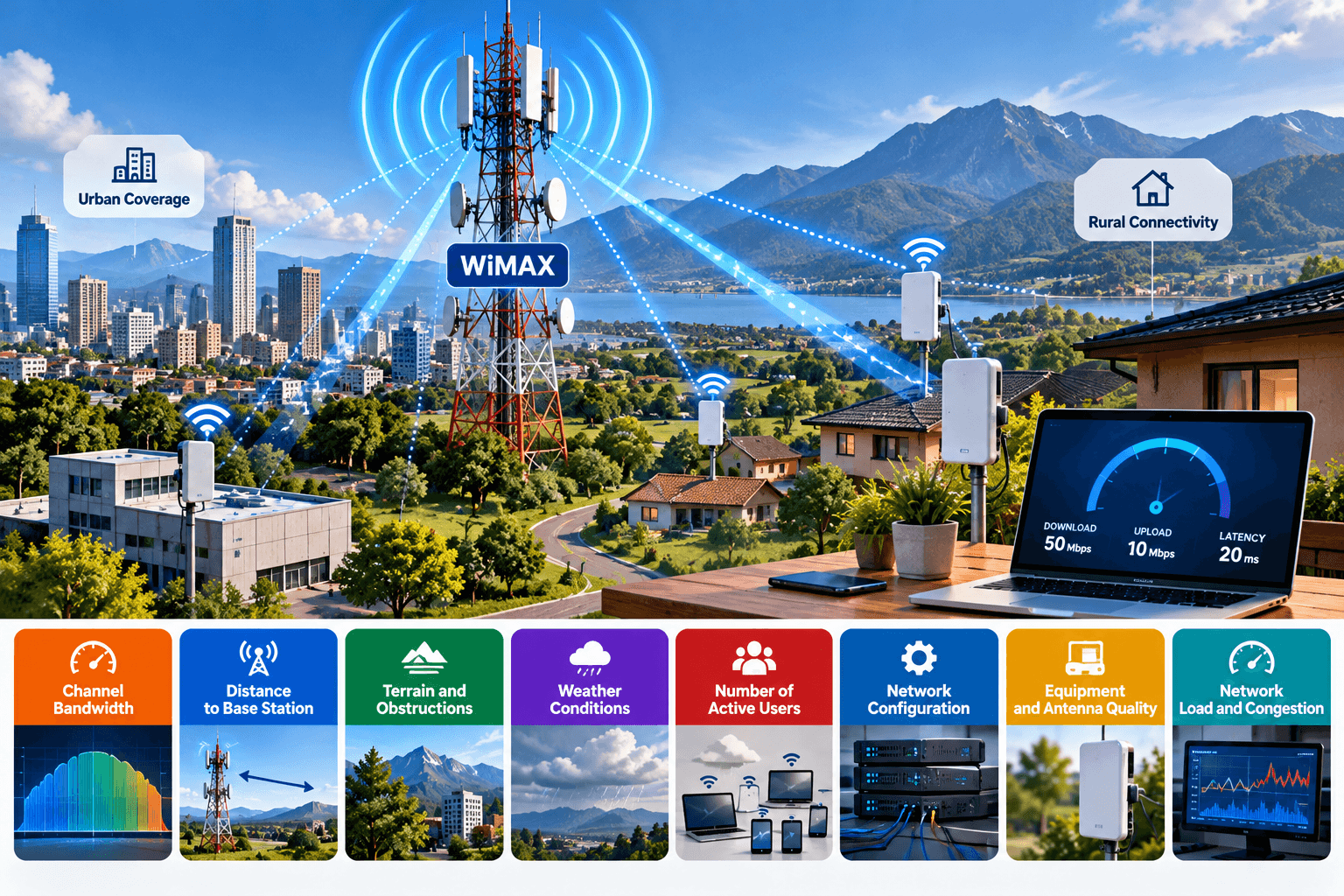
Understanding WiMAX Throughput: Key Factors and Performance
WiMAX, short for Worldwide Interoperability for Microwave Access, was a wireless broadband technology developed around the IEEE 802.16 family of standards.
It was designed to provide broadband connectivity over wireless links, particularly where deploying traditional wired infrastructure could be difficult or expensive.
Like other wireless technologies, WiMAX performance depends on much more than the maximum data rate associated with a particular standard. Network configuration, radio conditions, distance, channel characteristics, equipment, and the number of active users can all affect the throughput a user actually experiences.
What Is WiMAX?
WiMAX refers to wireless broadband systems based on the IEEE 802.16 standards.
The technology was designed to provide broadband connectivity over significantly larger coverage areas than traditional local-area Wi-Fi networks.
WiMAX could be used for applications such as:
- Fixed wireless broadband
- Last-mile connectivity
- Enterprise connectivity
- Internet access
- Backhaul
- Metropolitan-area wireless networks
The technology evolved over time, with different IEEE 802.16 standards and profiles supporting different capabilities.
What Is IEEE 802.16d?
IEEE 802.16d is commonly associated with the fixed version of WiMAX and is also referred to as 802.16-2004 in the development of the standard.
It was designed primarily around fixed wireless broadband applications rather than the mobile connectivity associated with later WiMAX developments.
This distinction is important because WiMAX wasn’t a single technology with one universal throughput figure. Performance depended on the specific standard, frequency, channel bandwidth, modulation and coding, deployment configuration, and radio conditions.
What Does Throughput Mean?
Throughput is the amount of useful data that can actually be delivered over a network connection during a given period.
It is different from the theoretical maximum data rate advertised for a technology.
For example, a wireless system might have a specified maximum physical-layer data rate, but the amount of usable application data received by an individual user can be lower because of:
- Protocol overhead
- Network contention
- Signal conditions
- Interference
- Distance
- Radio configuration
- Shared capacity
- Equipment limitations
This distinction is important when evaluating any wireless broadband technology, including WiMAX.
What Affects WiMAX Throughput?
1. Signal Strength and Quality
The quality of the wireless signal can have a significant effect on performance.
A strong, clean signal generally provides better conditions for higher data rates. As signal quality deteriorates, the system may need to use a more robust transmission configuration, which can reduce throughput.
Factors affecting signal quality can include:
- Distance from the base station
- Obstructions
- Buildings
- Terrain
- Antenna configuration
- Interference
- Weather and propagation conditions
A network therefore cannot be evaluated based solely on the theoretical capabilities of its standard.
2. Distance From the Base Station
Distance is another important consideration in fixed wireless deployments.
As the wireless link becomes more challenging, maintaining high data rates can become more difficult.
The actual relationship between distance and throughput isn’t simply a fixed number of megabytes per kilometre. Antenna characteristics, frequency, transmit power, terrain, line of sight, channel conditions, and network configuration all influence the result.
For this reason, coverage and throughput should be measured based on the specific deployment rather than assuming that every WiMAX installation will deliver the same performance at a particular distance.
3. Channel Bandwidth
The amount of spectrum allocated to a wireless connection affects the potential capacity available to the system.
In general, a wider channel can provide greater capacity when other conditions are suitable, although it also involves considerations around spectrum availability, interference, regulatory requirements, and network design.
The bandwidth available to an individual subscriber can also depend on how the network operator allocates resources.
4. Modulation and Coding
Wireless systems can adapt their transmission methods according to radio conditions.
Higher-order modulation can carry more bits per symbol, potentially increasing data rates when signal quality is good.
When conditions deteriorate, a system may use a more robust configuration that sacrifices data rate for reliability.
This creates an important trade-off:
Better radio conditions can support higher data rates, while poorer conditions may require more robust transmission.
5. Network Congestion and User Density
Wireless broadband capacity can be shared among multiple users.
If many subscribers are actively using the network at the same time, the available capacity may have to be divided among them.
This means that a user may experience different throughput at different times of day even when the physical connection hasn’t changed.
For example, a network may perform differently during:
- Business hours
- Evening peak periods
- Weekends
- Major events
- Other periods of unusually high demand
Therefore, advertised maximum throughput should not automatically be interpreted as the speed every user will receive simultaneously.
6. Network Architecture and Configuration
WiMAX performance also depends on how the network itself has been designed.
Factors can include:
- Base-station capacity
- Backhaul capacity
- Frequency planning
- Sector configuration
- Scheduling
- Antenna configuration
- Subscriber equipment
- Traffic management
A high-capacity wireless link can still provide poor user experience if another part of the network becomes a bottleneck.
The Difference Between Capacity and User Throughput
One of the most important concepts when discussing WiMAX performance is the difference between system capacity and individual-user throughput.
A network’s overall capacity represents the amount of traffic its infrastructure can potentially handle under particular conditions.
Individual-user throughput is what a specific customer actually receives.
These aren’t necessarily the same.
For example, available capacity may be shared among multiple subscribers, while some of the wireless channel is also consumed by protocol and network overhead.
When evaluating a wireless broadband service, ask the provider about expected or measured throughput under realistic operating conditions, rather than relying only on the maximum theoretical figure.
How WiMAX Compared With Wi-Fi
WiMAX and Wi-Fi are both wireless networking technologies, but they were designed for different types of applications.
Wi-Fi is primarily associated with wireless local area networking, such as connecting devices within homes, offices, schools, and other local environments.
WiMAX was designed for broader wireless broadband deployments and could be used to provide connectivity across larger geographic areas.
The two technologies therefore shouldn’t be compared simply by asking which one has the higher maximum speed.
The appropriate technology depends on factors such as:
- Coverage requirements
- Number of users
- Available infrastructure
- Frequency spectrum
- Deployment environment
- Required capacity
- Mobility requirements
- Cost
For more information about wireless networking concepts, see Archer’s guide to the different types of wireless networks.
You can also read about the evolution of Wi-Fi technology to see how wireless LAN technology has developed over time.
How to Measure Wireless Throughput
If you’re evaluating the performance of a wireless network, theoretical specifications aren’t enough.
A practical test should consider:
- Location — Where is the client device relative to the base station or access point?
- Signal quality — What are the signal and radio conditions?
- Time of day — Is the network experiencing peak demand?
- Client equipment — What wireless hardware is being used?
- Connection method — Is the test measuring the wireless link or the wider internet connection?
- Backhaul capacity — Could another part of the network be limiting performance?
- Multiple users — Does performance change when several users are active?
Testing under different conditions gives a much more useful picture than a single speed test.
Why Theoretical Speed Isn’t the Whole Story
It is tempting to compare wireless technologies based on their maximum advertised data rates.
However, maximum data rate is only one part of network performance.
A business should also consider:
- Reliability
- Latency
- Coverage
- Capacity
- Interference
- Security
- Scalability
- Equipment availability
- Infrastructure requirements
- Cost
A connection with a lower theoretical maximum can be more useful in practice if it provides reliable and consistent performance for the application’s actual requirements.
Is WiMAX Still Relevant?
WiMAX played an important role in the development of fixed and mobile broadband wireless networking.
However, the wireless broadband landscape has changed considerably since the technology’s early development. Other technologies and network architectures have become more widely used for many modern broadband deployments.
The historical importance of WiMAX remains useful because it illustrates the challenges involved in delivering broadband connectivity wirelessly across larger areas.
Understanding those principles also helps explain why modern wireless networks require careful consideration of spectrum, radio conditions, capacity, interference, and network architecture.
Improving Wireless Network Performance
Whether you’re working with WiMAX, Wi-Fi, or another wireless technology, performance problems should be investigated systematically.
Start by determining whether the problem is caused by:
- Poor signal coverage
- Interference
- Network congestion
- Faulty equipment
- Incorrect configuration
- Insufficient bandwidth
- A server or application problem
- An internet service issue
For local wireless problems, Archer’s guide on weak Wi-Fi and router placement provides additional information about improving wireless coverage.
For businesses experiencing broader connectivity or infrastructure problems, Archer IT Solutions provides IT support and network-related services.
Understanding WiMAX Throughput
WiMAX throughput cannot be reduced to one universal speed.
Although specific IEEE 802.16 configurations can have defined theoretical data rates, the throughput experienced by an individual user depends on the complete wireless environment and network architecture.
Signal quality, distance, channel bandwidth, modulation and coding, interference, network congestion, equipment, and backhaul capacity can all influence actual performance.
The most useful way to evaluate a wireless broadband network is therefore to consider measured performance under realistic operating conditions, rather than relying solely on a theoretical maximum.
If your business needs help diagnosing network performance or improving its IT infrastructure, contact Archer IT Solutions to discuss your requirements.


No responses yet