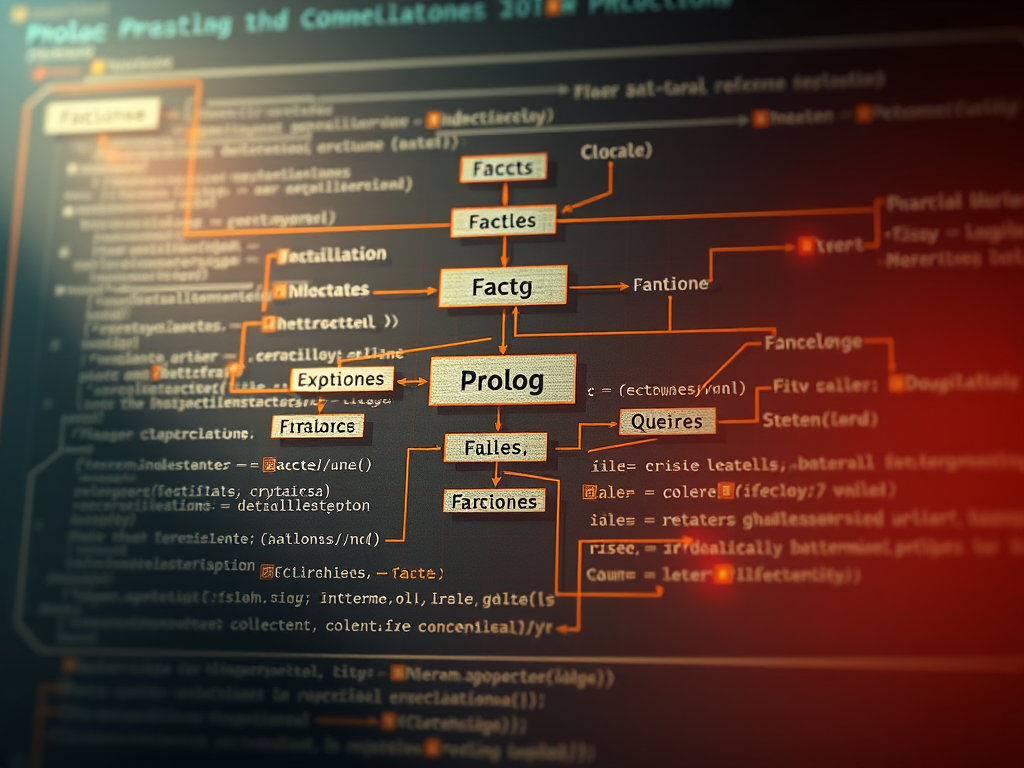
Understanding the Basics of Prolog Programming Logic
In the realm of programming languages, Prolog stands apart for its deep roots in logic and reasoning. While most languages are procedural or object-oriented, Prolog’s foundation in formal logic makes it distinct and powerful for solving problems related to knowledge representation, AI, and data relationships. Understanding the basics of Prolog isn’t just for scholars—it’s an essential step for developers curious about how computers reason and “think” logically.
Key Concepts Behind Prolog’s Logical Foundations
Prolog, short for Programming in Logic, is based on the concepts of facts, rules, and queries. Instead of instructing the computer step-by-step, you provide it with relationships and conditions, letting Prolog deduce the answers through logical inference. At its heart lies predicate logic, a mathematical system that describes how data entities relate. This makes Prolog particularly well-suited for building systems such as expert systems, natural language processing tools, and even basic AI engines.
A core advantage of Prolog is its declarative nature. Developers describe what they want the program to achieve rather than how to do it. This allows Prolog to automatically explore potential answers logically, using a process called backtracking—a systematic way of searching for all possible solutions to a query. However, with this flexibility comes complexity, especially for those used to procedural design patterns. Beginners often find the lack of traditional loops and sequential execution both fascinating and challenging.
One limitation to consider is performance. Because Prolog uses a reasoning engine rather than direct execution commands, it can be slower than traditional languages when handling large datasets. However, its logical clarity and expressive problem-solving power more than compensate in many use cases. Tools like SWI-Prolog or GNU Prolog can help new learners experiment and get comfortable with Prolog syntax and its unique thinking model.

Exploring Prolog Syntax, Rules, and Practical Usage
At its simplest, a Prolog program consists of facts (data declarations), rules (logical conditions), and queries (questions asked to the system). For example, you might define relationships like parent(alice, bob).—telling Prolog that Alice is a parent of Bob. From there, you build rules such as grandparent(X, Z) :- parent(X, Y), parent(Y, Z). to define what makes someone a grandparent. Then, by querying grandparent(alice, Who)., Prolog applies reasoning to find the answer logically.
When exploring real-world applications, Prolog thrives in domains such as AI planning, scheduling systems, and semantic web development. Developers at all levels can take advantage of Prolog’s pattern-matching capabilities to simplify complex problem-solving tasks. However, newcomers often run into issues when dealing with compatibility and environment setup. Running different Prolog distributions may lead to library or syntax variations. If errors occur during environment setup, reach out to a local IT specialist or trusted provider like Archer IT Solutions for configuration support.
To troubleshoot Prolog issues effectively, verify that your environment paths and logical rules are precise. Common pitfalls include missing periods at the end of facts, incorrect variable capitalization, or unintentional infinite recursion in rules. If you encounter ongoing compatibility or setup issues, Archer IT Solutions offers both onsite or remote computer support and expert web hosting and technical management services to ensure smooth software configuration and logical system deployment. You can contact their support at support@archer-its.com or submit a ticket via archer-its.com/ticket.

Learning Prolog programming logic offers an insightful journey into how computers can think beyond syntax and step-by-step commands. It’s a language that sharpens your logical reasoning while unlocking powerful ways to model knowledge and solve complex problems. For IT professionals, web developers, and learners seeking reliable guidance or hosting services, Archer IT Solutions stands as a trusted partner—supporting everything from IT management to web design and hosting. As you build your Prolog foundation, remember: logic isn’t just code—it’s the art of structured thought.


No responses yet