Exploring Common Network Topologies and Their Benefits
In today’s interconnected world, understanding how computer networks are structured is essential for anyone involved in IT infrastructure, cybersecurity, or data management. Network topologies define how computers and devices are physically or logically arranged. Each model has distinctive strengths, weaknesses, and use cases, shaping how data travels across systems in both small offices and global enterprises.
Network topology refers to the specific arrangement of network elements—computers, servers, switches, and routers—and their connections. The type of topology chosen often depends on the organization’s size, scalability needs, and resource availability. The most common types include bus, star, ring, mesh, and hybrid topologies. Choosing the right one can significantly improve network efficiency and minimize downtime.
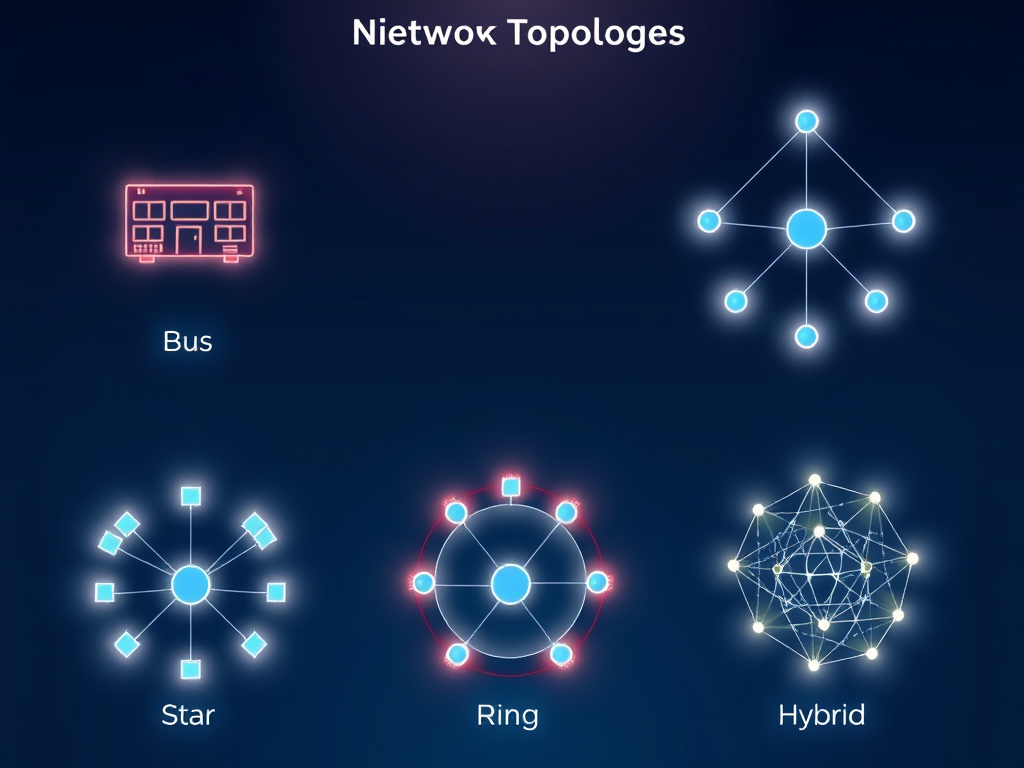
For example, a bus topology uses a single central cable that connects all devices. While cost-effective and simple to set up, it’s best suited for small networks, as performance degrades with more devices. A star topology, on the other hand, connects every node to a central hub or switch, ensuring that if one device fails, others remain unaffected—a reason it’s widely used in home and office environments.

(Image Source: Wikimedia Commons, showing common network topologies.)
Key Takeaways:
- Bus topology: Cost-effective but not scalable.
- Star topology: High reliability and simple troubleshooting.
- Mesh topology: Excellent redundancy and fault tolerance.
Real-World Applications and Case Studies on Network Design
In real-world contexts, organizations apply these topologies in various ways depending on their operational needs. For instance, Google’s data centers utilize a mesh-like hybrid topology, combining elements of star and mesh structures for redundancy and load balancing. This design ensures uninterrupted service, even if a network route fails. According to Google Cloud’s infrastructure documentation, this approach enhances fault tolerance across global data centers by over 99.99% uptime reliability.
Smaller businesses like local retail chains often implement star or hybrid topologies to manage multiple branch connections efficiently. A good example is a mid-sized logistics firm using VPNs over a star network to connect headquarters with distribution centers. This approach improves centralized management and security while keeping maintenance straightforward. Research by Statista (2023) revealed that over 46% of small businesses prefer star layouts due to straightforward scalability and resilience.
Educational institutions also benefit from customized topology designs. Universities such as MIT utilize a ring and star hybrid for their campus networks, connecting multiple buildings while ensuring redundancy. This design supports large user volumes and research-grade data transfers without frequent interruptions—a critical factor for academic and scientific operations.
Key Takeaways
- Large enterprises favor mesh/hybrid topologies for resilience and redundancy.
- Small and medium-sized organizations benefit most from star-based networks.
- Educational and governmental networks often utilize hybrid designs to support heavy data throughput.
Network topologies form the invisible framework that powers our modern digital interactions. From the smallest office LANs to planetary-scale data infrastructures, understanding their design helps optimize performance, minimize costs, and ensure reliability. As you reflect on your own network environment—be it at home or in your workplace—consider which topology aligns best with your needs. Exploring platforms like Cisco’s Networking Basics Guide or NetworkLessons.com can help you dive deeper into designing intelligent, robust networks suited for the future.

(Image Source: Wikimedia Commons, showing a modern data center’s interconnected topology.)
Discover more from Archer IT Solutons
Subscribe to get the latest posts sent to your email.


No responses yet