The Birth of Wi-Fi: How the 1997 IEEE 802.11 Standard Changed Wireless Networking
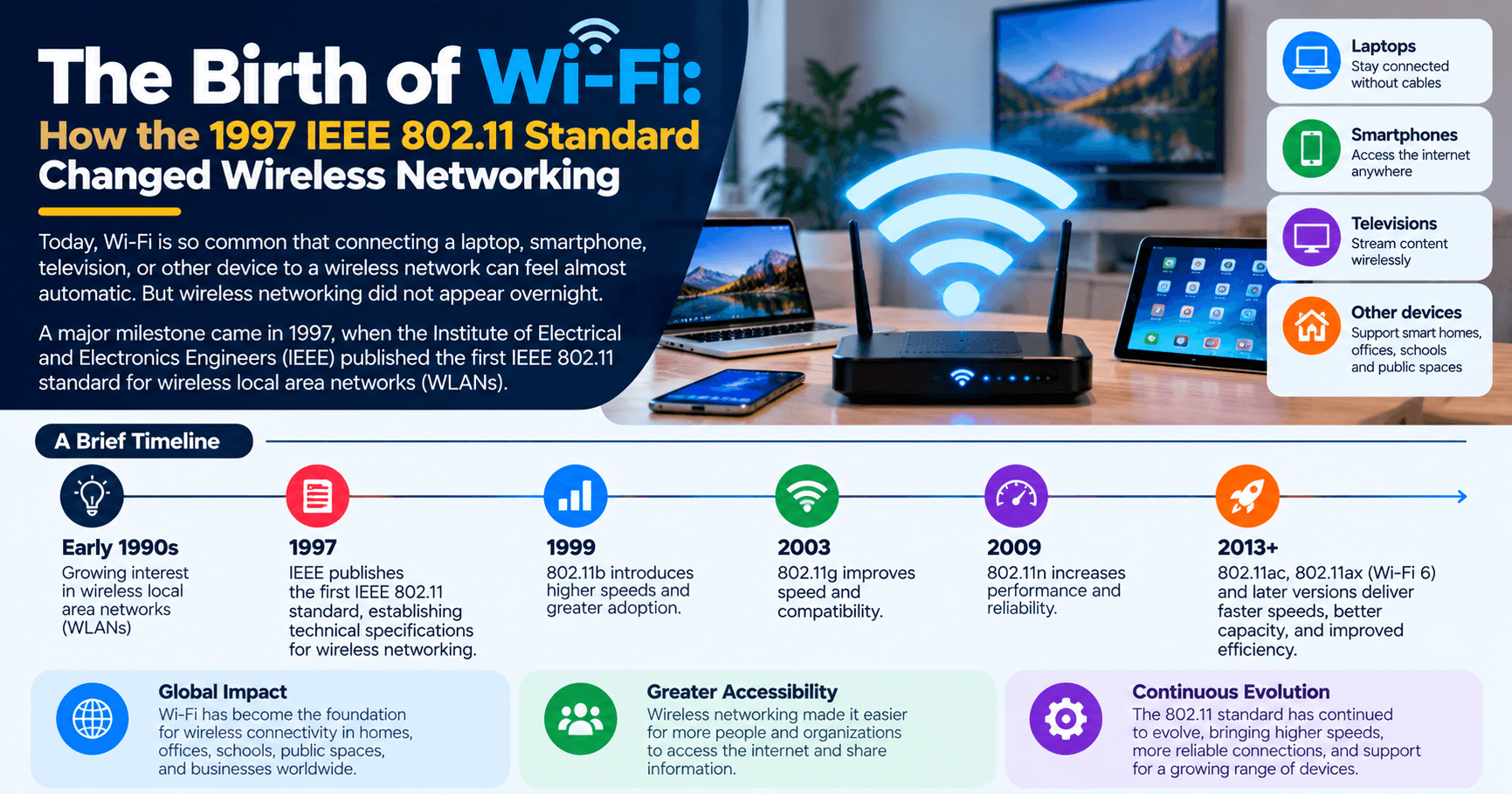
Today, Wi-Fi is so common that connecting a laptop, smartphone, television, or other device to a wireless network can feel almost automatic.
But wireless networking did not appear overnight.
A major milestone came in 1997, when the Institute of Electrical and Electronics Engineers (IEEE) published the first IEEE 802.11 standard for wireless local area networks (WLANs). The standard established technical specifications for how compatible wireless devices could communicate over a local network.
The technology continued to evolve considerably after 1997, eventually becoming the foundation of the Wi-Fi connectivity used in homes, offices, schools, public spaces, and businesses around the world.
What Was IEEE 802.11?
IEEE 802.11 is a family of standards that defines how wireless local area networks operate.
The original IEEE 802.11-1997 standard specified both:
- MAC (Media Access Control) functions, which govern how devices access and communicate across the wireless network.
- PHY (Physical Layer) specifications, which describe how data is transmitted over the wireless medium.
The original standard included two radio-based physical layers operating in the 2.4 GHz band, as well as an infrared physical layer.
This standardization was important because wireless networking requires devices from different manufacturers to follow common technical rules if they are going to communicate reliably.
Was Wi-Fi Really Invented in 1997?
It’s more accurate to say that 1997 marked the publication of the first IEEE 802.11 standard, rather than saying Wi-Fi was simply “invented” that year.
Wireless networking technologies existed before the 802.11 standard. IEEE’s own historical material describes earlier work that contributed to the development of wireless LAN technology.
What the 1997 standard provided was a common technical framework for wireless LAN communication.
The IEEE 802.11 standard was published on November 18, 1997.
That standard became the starting point for decades of subsequent wireless networking development.
What Could the Original 802.11 Standard Do?
The original 802.11 standard operated in the 2.4 GHz range and supported wireless data transmission at relatively modest speeds compared with today’s Wi-Fi networks.
IEEE’s historical overview notes that the original 1997 technology supported data transmission at up to approximately 2 Mbit/s.
By modern standards, that may seem extremely slow. But the significance of the standard was not simply its speed.
It established a standardized method for wireless devices to communicate within a local network without requiring a physical network cable between every device.
That was an important step toward the wireless connectivity businesses and consumers now take for granted.
The Development of 802.11 After 1997
The original standard was only the beginning.
IEEE continued developing amendments to improve wireless networking performance, range, reliability, functionality, and security.
Some important milestones include:
802.11b — 1999
IEEE 802.11b increased wireless data rates and continued operating in the 2.4 GHz band.
It helped make wireless networking more practical for mainstream use, with theoretical data rates reaching up to 11 Mbit/s.
802.11a — 1999
IEEE 802.11a introduced wireless networking in the 5 GHz band and supported higher theoretical data rates than the original standard.
It also used OFDM (Orthogonal Frequency-Division Multiplexing), an important technology in the development of faster wireless networks.
802.11g — 2003
802.11g brought higher data rates to the 2.4 GHz band, with theoretical rates of up to 54 Mbit/s.
This helped extend the usefulness of wireless networking for increasingly demanding applications.
802.11n — Wi-Fi 4
802.11n represented another major improvement, supporting both 2.4 GHz and 5 GHz operation and introducing technologies that significantly increased throughput.
IEEE’s Wi-Fi history identifies 802.11n as the basis for Wi-Fi 4.
802.11ac — Wi-Fi 5
802.11ac brought further improvements, particularly in the 5 GHz band, and made extensive use of multiple-input, multiple-output (MIMO) technology.
It became known commercially as Wi-Fi 5.
802.11ax — Wi-Fi 6
802.11ax, marketed as Wi-Fi 6, was designed to improve wireless performance and efficiency, particularly in environments where many devices compete for network capacity.
IEEE identifies Wi-Fi 6 as supporting theoretical data rates of up to 9.6 Gbit/s and targeting increasingly demanding applications such as video and cloud services.
From 802.11 to the Wi-Fi Generations We Know Today
The term Wi-Fi is commonly used to describe products and networks based on the IEEE 802.11 family of wireless LAN standards.
As the technology evolved, the Wi-Fi Alliance introduced simplified generation names to make the different versions easier for consumers to understand.
For example:
| IEEE standard | Common Wi-Fi generation |
|---|---|
| 802.11n | Wi-Fi 4 |
| 802.11ac | Wi-Fi 5 |
| 802.11ax | Wi-Fi 6 |
The simplified naming system makes it easier to compare newer wireless technologies without having to remember the technical IEEE amendment names.
Why the 1997 Standard Was Important
The importance of IEEE 802.11 goes beyond the speed of the original technology.
Standardization helped create an ecosystem in which manufacturers could build wireless networking equipment around common specifications.
That made it possible for wireless networking to develop through successive generations rather than remaining a collection of incompatible proprietary technologies.
Over time, improvements in wireless standards contributed to:
- Faster data transmission
- Better network efficiency
- Support for more connected devices
- Improved wireless reliability
- Greater mobility
- More sophisticated security mechanisms
- Support for increasingly demanding applications
Modern wireless networking is therefore the result of decades of incremental development rather than a single invention in 1997.
How Wi-Fi Changed Business Networking
Wireless networking fundamentally changed how businesses can design their networks.
Employees can connect laptops and mobile devices without requiring a physical Ethernet connection at every workstation. Visitors can be provided with separate wireless access. Mobile devices can remain connected while users move around a workplace.
Wi-Fi is now commonly used for:
- Employee laptops
- Smartphones and tablets
- Printers
- VoIP devices
- Smart displays
- IoT devices
- Guest networks
- Point-of-sale systems
- Meeting-room equipment
However, a wireless network still needs to be properly designed and secured.
The availability of Wi-Fi does not eliminate the need for sound network infrastructure.
Why Wireless Network Design Still Matters
A modern Wi-Fi network can involve access points, routers, switches, wireless channels, authentication systems, firewalls, and other network components.
Poor placement of wireless equipment can lead to:
- Weak signals
- Dead zones
- Interference
- Inconsistent performance
- Congestion
- Unreliable connections
Businesses should therefore consider their physical environment, number of users, devices, applications, and security requirements when designing a wireless network.
If you’re experiencing wireless connectivity problems, Archer IT Solutions has resources covering router placement and weak Wi-Fi signals as well as different types of wireless networks.
You can also learn more about the role of network interface cards in connectivity and how networking components work together.
Wi-Fi Is Still Evolving
The story that began with the publication of IEEE 802.11 in 1997 did not end with the first standard.
Wireless networking continues to evolve as businesses and consumers demand greater capacity, lower latency, better efficiency, stronger security, and support for increasing numbers of connected devices.
The progression from the original 802.11 standard through Wi-Fi 4, Wi-Fi 5, Wi-Fi 6, and newer generations illustrates how networking technology has continuously adapted to changing requirements.
For businesses, this means that choosing wireless equipment should not be based solely on the highest advertised speed. Compatibility, coverage, security, device density, network design, and the actual requirements of the organization are equally important.
The Legacy of the 1997 IEEE 802.11 Standard
The 1997 IEEE 802.11 standard was a significant milestone in the development of wireless local area networking.
It did not create every technology that eventually became associated with Wi-Fi, but it established an important standardized foundation for wireless LAN communication.
More than two decades later, the principles and standards developed through the IEEE 802.11 family continue to underpin wireless networking.
For businesses that need help with wireless connectivity, networking, or broader IT infrastructure, Archer IT Solutions provides IT support and related technology services.
If your organization needs assistance troubleshooting or improving its network, contact Archer IT Solutions to discuss your requirements.


No responses yet