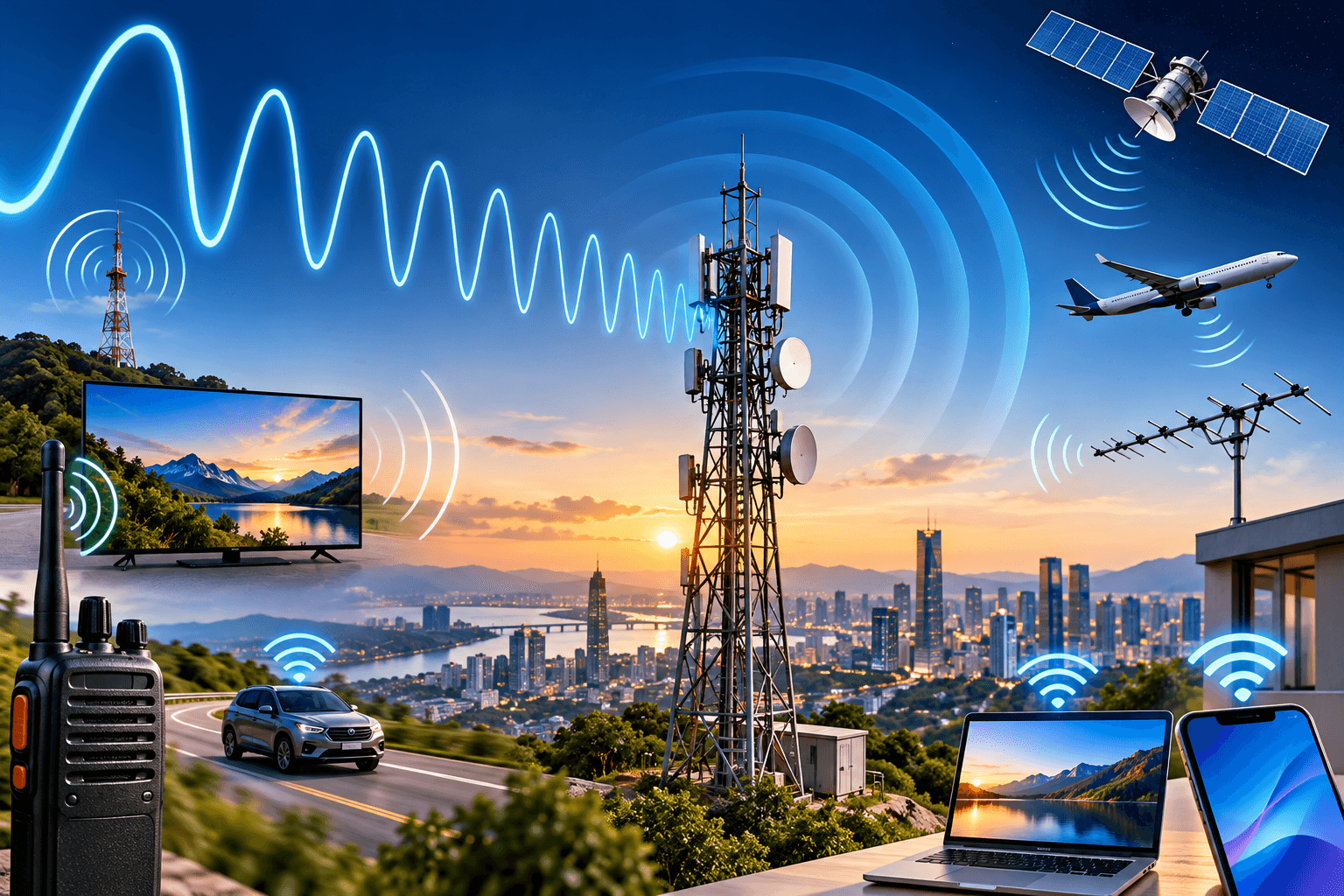
UHF Wavelength Explained: Frequency, Range, and Common Uses
Ultra high frequency (UHF) is a range of radio frequencies used for many types of wireless communication. UHF covers frequencies from 300 MHz to 3 GHz, corresponding to wavelengths of approximately 1 meter to 10 centimeters.
Understanding the relationship between UHF frequency and wavelength can help explain how radio signals behave and why different frequencies are selected for applications such as television broadcasting, mobile communications, two-way radio, and other wireless systems.
What Is UHF?
UHF stands for Ultra High Frequency. It is part of the radio-frequency spectrum between very high frequency (VHF) and super high frequency (SHF).
According to the International Telecommunication Union (ITU), UHF occupies the 300 MHz to 3 GHz frequency range.
The corresponding wavelengths are approximately:
- 300 MHz: 1 meter
- 600 MHz: 50 centimeters
- 1 GHz: 30 centimeters
- 2 GHz: 15 centimeters
- 3 GHz: 10 centimeters
These values are based on radio waves traveling through free space.
How Are UHF Wavelengths Calculated?
Frequency and wavelength are closely related. As the frequency of a radio wave increases, its wavelength becomes shorter.
The relationship can be expressed as:
Wavelength = wave speed ÷ frequency
For radio waves traveling through free space, the wave speed is approximately the speed of light.
For example, a 300 MHz signal has a wavelength of approximately 1 meter, while a 3 GHz signal has a wavelength of approximately 10 centimeters.
This relationship is important when designing or evaluating wireless communication systems because frequency affects antenna dimensions and how signals interact with their surroundings.
Where Is UHF Used?
UHF frequencies are used across a wide range of wireless communication applications.
Television Broadcasting
UHF has historically been widely used for terrestrial television broadcasting. Different countries allocate specific portions of the UHF spectrum for broadcasting and other services. The ITU maintains information on the use of VHF and UHF bands for terrestrial broadcasting.
Mobile Communications
Parts of the UHF range are used for mobile communications. The exact frequencies available depend on the country, network technology, and regulatory allocation.
Two-Way Radio
UHF frequencies are also used by various two-way radio systems, including communications used in business, industrial, public-safety, and other environments.
Other Wireless Systems
Different portions of the UHF spectrum can support a variety of wireless applications. The specific use of a frequency depends on technical requirements and local regulations.
Why Does UHF Wavelength Matter?
Wavelength affects how a radio signal interacts with antennas, buildings, terrain, and other objects.
Because UHF wavelengths are relatively short compared with lower-frequency radio waves, antennas designed for UHF systems can generally be smaller than antennas designed for lower frequencies.
However, wavelength alone does not determine wireless coverage or performance.
Other factors include:
- Transmitter power
- Antenna design and placement
- Distance between devices
- Building materials
- Terrain and physical obstructions
- Interference from other signals
- Receiver sensitivity
- The specific frequency being used
For businesses, these factors can become important when wireless connectivity needs to remain reliable across an office or other working environment.
UHF vs. VHF: What’s the Difference?
UHF and VHF are two different sections of the radio-frequency spectrum.
VHF (Very High Frequency) covers approximately 30 MHz to 300 MHz, while UHF covers 300 MHz to 3 GHz.
Because UHF operates at higher frequencies, its wavelengths are shorter.
| Feature | VHF | UHF |
|---|---|---|
| Frequency range | 30–300 MHz | 300 MHz–3 GHz |
| Wavelength | Longer | Shorter |
| Typical antenna size | Generally larger | Generally smaller |
| Common applications | Radio, aviation and other communications | Television, mobile and other wireless communications |
Neither frequency range is automatically better. The appropriate choice depends on the application, equipment, environment, required coverage, and applicable regulations.
Can UHF Signals Travel Through Walls?
UHF signals can pass through some building materials, but walls and other physical obstacles can weaken radio signals.
The amount of signal loss depends on factors such as the material, thickness of the obstruction, frequency, antenna configuration, and distance.
This is one reason wireless performance can vary considerably between rooms in an office or building.
If you’re experiencing unreliable Wi-Fi or wireless connectivity, frequency is only one part of the problem. Router placement, interference, network configuration, and physical obstructions can also affect performance. Archer’s guide on how to improve Wi-Fi signal through better router placement covers some of these practical considerations.
UHF Wavelength and Wireless Network Performance
Understanding radio frequency can also help put wireless networking problems into context.
A business may experience weak wireless coverage because of the building layout, interference, poor equipment placement, outdated hardware, or other network configuration issues. Simply increasing signal strength is not always the right solution.
Archer IT Solutions provides remote and onsite IT support for businesses dealing with connectivity and technology problems. If wireless problems are affecting your business operations, the issue may require an assessment of the wider network rather than a simple equipment change. Archer’s existing networking resources also cover different types of wireless networks and common connectivity considerations.
Key Takeaway
UHF, or Ultra High Frequency, covers the 300 MHz to 3 GHz range and has wavelengths of approximately 1 meter to 10 centimeters.
The relationship between frequency and wavelength helps explain how wireless signals behave and why different frequency ranges are used for different communication systems.
However, reliable wireless communication depends on much more than wavelength. Antenna design, equipment, interference, physical obstructions, distance, and the surrounding environment all play a role.
For businesses experiencing persistent network or connectivity problems, professional IT troubleshooting can help identify whether the underlying issue is related to wireless coverage, equipment, configuration, or another part of the network.
Contact Archer IT Solutions for assistance with business IT and network-related issues. Archer provides IT support, managed IT services, and other technology solutions for small and medium-sized businesses.


No responses yet