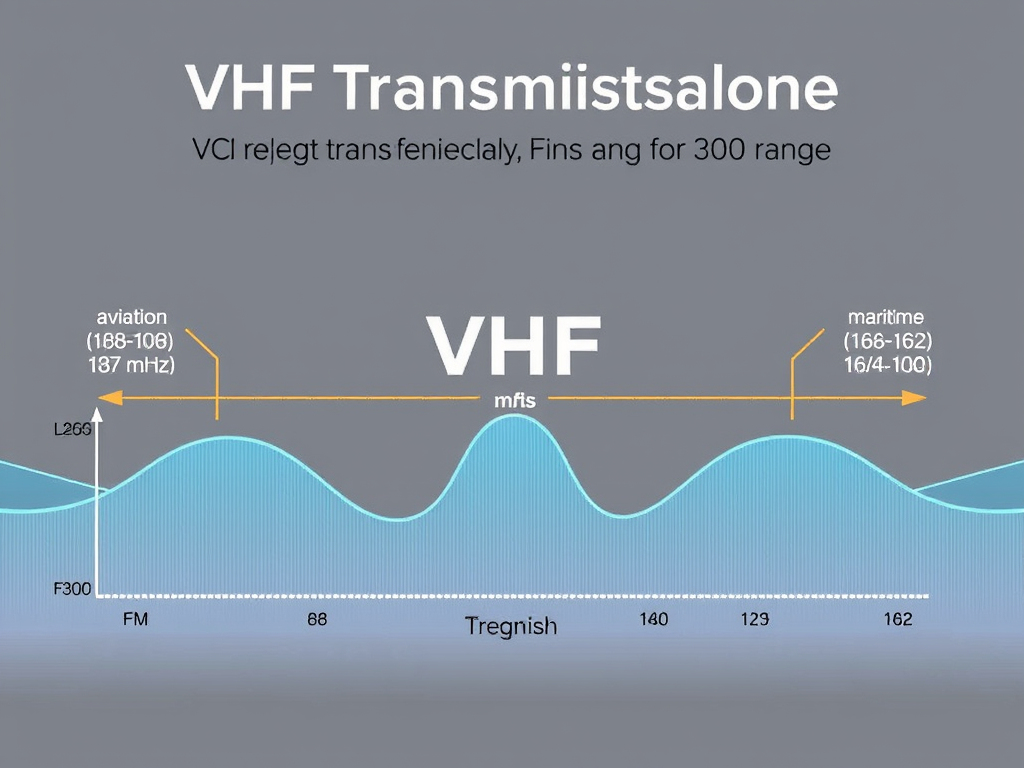
Understanding the Frequency Range of VHF Transmission
Very High Frequency (VHF) transmission operates between 30 MHz and 300 MHz, a critical spectrum for modern communication systems. From marine radios to aviation communication, this range provides clarity, range, and stability. Understanding its behavior can help both professionals and enthusiasts improve connectivity and optimize performance.
A visual overview of the radio frequency spectrum, including the VHF range.
Exploring the Core Frequency Bands of VHF Signals
VHF, or Very High Frequency, occupies a range from 30 MHz to 300 MHz, bridging the gap between lower HF (High Frequency) and higher UHF (Ultra High Frequency) signals. This span is further subdivided into smaller bands for specific uses: FM radio stations typically use 88 MHz to 108 MHz; land mobile and two-way communication systems often occupy 136 MHz to 174 MHz; and television broadcasting formerly relied on frequencies between 174 MHz and 230 MHz. This structure allows for efficient segmentation and reduces interference across services.
One of the key advantages of VHF is its ability to travel moderate distances while maintaining signal clarity. Unlike HF waves, which bounce off the ionosphere for long-range communication, VHF travels straight in line-of-sight paths, which makes it excellent for terrestrial and short-range communication. However, the signals can be blocked by mountains, buildings, or dense foliage. Therefore, it is often used in environments where clear paths or elevated antennas are available.
From a technical standpoint, operators benefit by optimizing antenna heights and adjusting frequency allocations according to application type. For instance, maritime users operating within 156 MHz to 162 MHz bands ensure clear ship-to-shore communication across wide coastal regions. Such configurations highlight how VHF’s frequency characteristics can be tailored to support both safety-critical and everyday communication needs.
Practical Applications and Troubleshooting VHF Systems
The versatility of VHF transmission spans numerous industries. In aviation, pilots and control towers rely on frequencies between 118 MHz and 137 MHz for flight coordination due to the low noise levels of VHF propagation. In public service and emergency response, handheld transceivers transmit on frequencies like 150 MHz, ensuring dependable contact during rescue operations. Even entertainment broadcasting, such as FM radio, demonstrates how VHF delivers quality audio over wide areas.
Pros:
- Provides clear line-of-sight communication
- Less interference compared to lower frequencies
- Works well for mobile radios, aircraft, and maritime systems
Cons:
- Limited range due to line-of-sight constraints
- Performance affected by tall obstacles
- Requires carefully tuned antennas
When troubleshooting VHF systems, technicians should focus on antenna alignment, cabling integrity, and frequency interference. Poor transmission quality often stems from damaged coaxial connectors or nearby electronic devices emitting overlapping signals. A practical step involves scanning the frequency band for strong external interference using spectrum analyzers. Maintaining proper grounding and choosing quality RF components can significantly reduce connection losses.
For professional IT environments that rely on dependable connectivity, Archer IT Solutions offers managed network support, hosted infrastructure, and remote troubleshooting. If your VHF or communication networks need optimization, reach our experts at support@archer-its.com or explore our service offerings at www.archer-its.com/managed-it-services.
A typical VHF antenna used for communication in open areas.
For more technical insights, you may refer to:
The study of the VHF frequency range reveals its continued importance in reliable, short-distance communication networks. Whether used for airborne coordination, marine navigation, or emergency operations, understanding this range allows for enhanced precision and performance. Businesses looking to enhance their IT infrastructure or integrate better communication systems can partner with Archer IT Solutions to design, deploy, and support solutions that ensure reliability and scalability.
Call to Action (CTA):
Enhance your network communication with expert IT consulting. Visit www.archer-its.com or contact sales@archer-its.com today to get started.
Discover more from Archer IT Solutons
Subscribe to get the latest posts sent to your email.


No responses yet