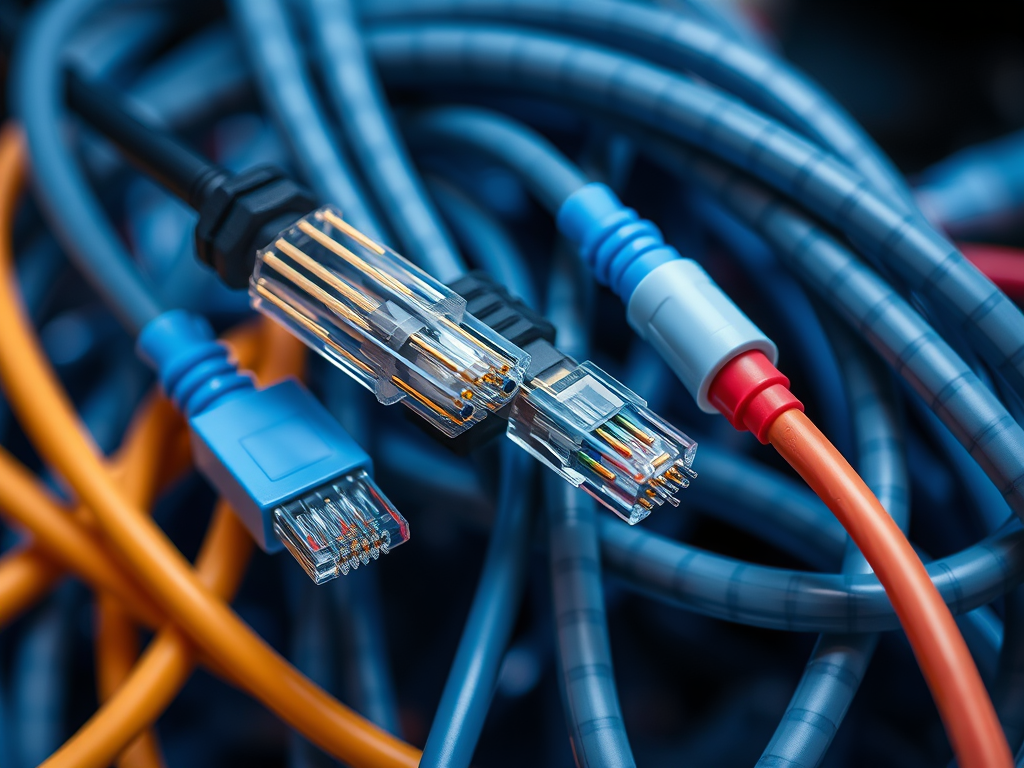
Network cables are essential components of computer networks that facilitate the transmission of data between devices. They work by carrying electrical signals, allowing devices such as computers, routers, switches, and servers to communicate with one another. Below is an overview of how network cables function, along with case studies and key takeaways.
How Network Cables Work
- Transmission Medium: Network cables use copper or fiber-optic materials as their medium to conduct electrical signals or light, respectively.
- Data Encoding: Information is encoded into electrical signals or light pulses, which travel through the cable to reach the receiving device.
- Protocols: Data transmission relies on protocols (such as Ethernet) to manage how data packets are sent, received, and interpreted.
Types of Network Cables
- Twisted Pair Cables: Commonly used in Ethernet networks, these cables consist of pairs of wires twisted together to reduce electromagnetic interference.
- Example: Cat5e and Cat6 cables maximize speed and reduce cross-talk.
- Coaxial Cables: Used primarily for cable television and internet connections, these cables consist of a single copper conductor surrounded by insulation and metallic shield.
- Example: RG-6 cable is often used in residential settings for high-speed internet.
- Fiber-Optic Cables: Utilize thin strands of glass or plastic to transmit data as light pulses, offering high speed and long-distance capability.
- Example: Single-mode and multimode fiber cables are used for varying distances and bandwidth needs.
Case Studies
- Case Study 1: Business Network Setup
- A medium-sized enterprise upgraded its network to Cat6 twisted pair cabling, resulting in:
- Enhanced speed up to 10 Gbps for bandwidth-intensive applications.
- Improved reliability with reduced downtime of network connections.
- Cost-effectiveness in terms of long-term maintenance.
- A medium-sized enterprise upgraded its network to Cat6 twisted pair cabling, resulting in:
- Case Study 2: Educational Institution Fiber-Optic Installation
- A university invested in a fiber-optic network to connect its campus buildings:
- Provided high-speed internet access for over 10,000 students and staff.
- Reduced latency for online educational resources, enhancing user experience.
- Scalable solution that accommodates future growth in technology and connectivity.
- A university invested in a fiber-optic network to connect its campus buildings:
Key Takeaways
- Network cables are vital for stable and efficient communication in digital environments.
- Choosing the right type of cable (twisted pair, coaxial, or fiber-optic) depends on factors like distance, bandwidth requirements, and environment.
- Upgrading to modern cabling can lead to significant operational improvements and cost savings.
Conclusion
Understanding the functioning and types of network cables is crucial for anyone managing a network. Whether for home use, small businesses, or large organizations, the right cabling choice can enhance speed, reliability, and overall performance.
As you reflect on your own needs, consider:
- What are your current bandwidth requirements?
- Are you experiencing issues with connectivity or speed?
- Is it time for an upgrade to improve your network infrastructure?
This reflection can guide you in making informed decisions about your network setup.
Discover more from Archer IT Solutons
Subscribe to get the latest posts sent to your email.


No responses yet