In today’s interconnected world, where streaming ultra-high-definition (UHD) videos, real-time online gaming, and cloud computing are common, the demand for faster and more efficient data transmission has never been higher. Within this context, one of the most important technologies underpinning wireless and wired communication speed is Quadrature Amplitude Modulation (QAM). Among its various implementations, 1024-QAM and 256-QAM are two modulation techniques that help define how much data can be transmitted in a given period. Understanding their differences is essential for network engineers, wireless service providers, and even end users interested in optimizing their connectivity. This article delves deep into how these two modulation schemes differ in terms of data capacity, error tolerance, and practical applications.
Understanding the Core Differences Between 1024-QAM and 256-QAM
At the heart of both 256-QAM and 1024-QAM lies the same concept — combining amplitude and phase modulation to represent data bits. QAM works by transmitting symbols, each symbol representing multiple bits of information through variations in amplitude and phase. The ‘number’ in QAM (like 256 or 1024) refers to the number of distinct symbol points available in the constellation diagram. For instance, 256-QAM uses 256 unique signal combinations, while 1024-QAM uses 1024. The higher this number, the greater the number of bits represented per symbol, enabling higher data throughput within the same channel bandwidth.
The main technical difference is bit density. 256-QAM can encode 8 bits per symbol (since 2⁸ = 256), while 1024-QAM encodes 10 bits per symbol (2¹⁰ = 1024). This means 1024-QAM has a 25% increase in data capacity compared to 256-QAM within the same spectrum. However, this improvement comes at the cost of increased susceptibility to noise and interference because as constellation points multiply, each one becomes closer to others, making accurate detection under imperfect conditions more difficult. To put it simply, 256-QAM can still remain stable under lower signal quality, but 1024-QAM demands a high signal-to-noise ratio (SNR) to perform efficiently.
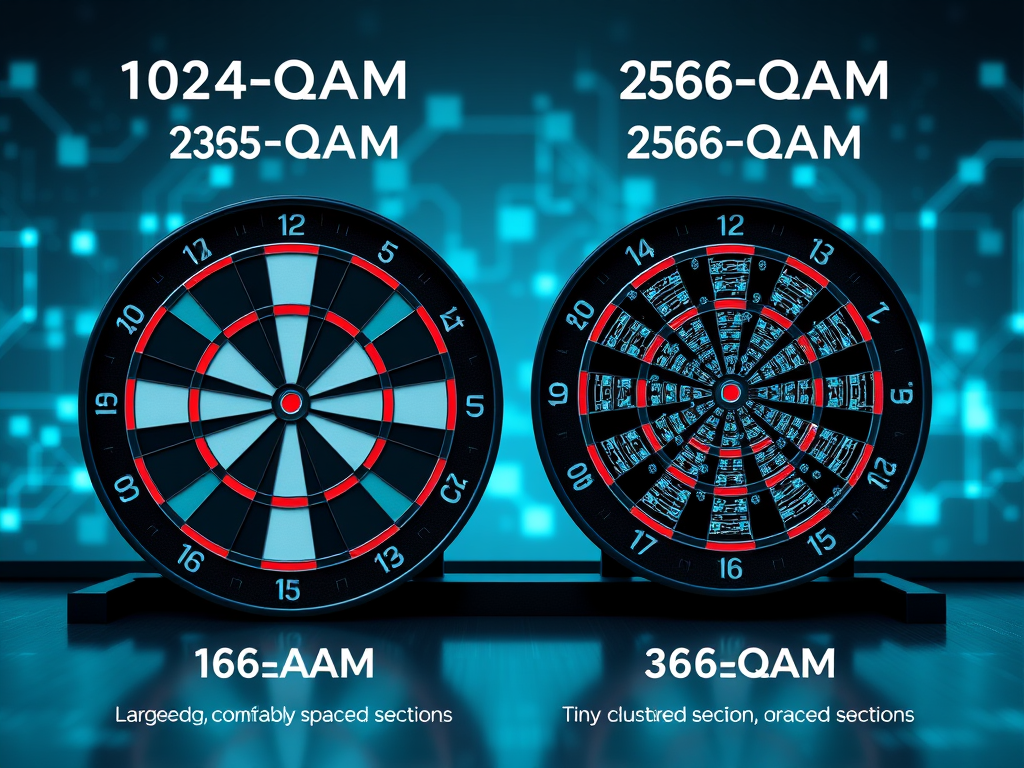
To understand this better, consider a common analogy. Imagine QAM as a dartboard where each symbol is a section. For 256-QAM, the sections are large and spaced comfortably apart — even if your aim is slightly off, you’ll likely hit the correct area. Conversely, in 1024-QAM, the board sections are tiny and tightly clustered, requiring significant precision. Therefore, while 1024-QAM increases data rates, it also amplifies vulnerability to environmental factors like interference, distance, and physical obstacles. This trade-off defines the real-world difference between these two modulation formats.
Key Differences Summary
-
Data Rate:
- 1024-QAM: Higher data rate, suitable for premium network performance.
- 256-QAM: Moderate data rate, more stable under weaker signals.
-
Signal Quality Requirement:
- 1024-QAM: Requires high SNR (typically above ~35 dB).
- 256-QAM: Operates efficiently with an SNR of ~28 dB or higher.
-
Energy Efficiency:
- 256-QAM can sometimes conserve more energy since it requires less transmission power to maintain stable communication at longer distances.
Pros and Cons of 1024-QAM vs 256-QAM
1024-QAM Pros:
- Higher throughput and better spectrum efficiency.
- Ideal for urban or dense network environments with strong SNR.
- Supports next-generation standards such as Wi-Fi 6E and early 5G deployments.
1024-QAM Cons:
- Requires near-ideal conditions and precise signal alignment.
- More prone to packet loss in noisy or long-distance scenarios.
- Can increase hardware complexity and cost in transceivers.
256-QAM Pros:
- Stable in moderate-quality channel environments.
- Efficient balance between performance and reliability.
- Widely supported in most existing Wi-Fi, LTE, and broadband infrastructure.
256-QAM Cons:
- Slightly lower data throughput compared to newer modulation schemes.
- May not fully utilize available spectrum in high-quality channels.
Real-World Applications and Performance of QAM Technologies
In practical terms, 256-QAM has been widely adopted in technologies like Wi-Fi 5 (802.11ac) and LTE-Advanced, while 1024-QAM is more common in Wi-Fi 6/6E and advanced 5G networks. For example, broadband providers such as Comcast and BT Group have integrated 1024-QAM into their latest network upgrades to achieve gigabit-level speeds without needing new frequency bands. These real-world applications demonstrate how modulation impacts overall performance — especially when user demand for bandwidth-intensive services continues to rise.
In wireless networking, the choice between 256-QAM and 1024-QAM usually depends on signal conditions. Urban areas with dense infrastructure can sustain high SNR, making 1024-QAM feasible. In contrast, rural or obstructed regions often revert to lower modulation schemes like 64-QAM or 256-QAM, which are more resilient. One clear case study can be seen in fiber-to-home broadband systems, where providers have successfully increased downstream rates by 20–25% using 1024-QAM in stable link environments. However, this performance boost sharply declines when line noise exceeds certain thresholds.
Additionally, mobile network operators face similar trade-offs. In 5G Non-Standalone (NSA) mode, using 1024-QAM can increase throughput for users in strong signal areas, but maintaining that modulation for all users simultaneously is not feasible. As a result, techniques like adaptive modulation and coding (AMC) dynamically switch between modulation schemes based on real-time signal conditions. This ensures that end users get the best possible balance between speed and reliability.
Performance Data Snapshot
To illustrate the impact, the following performance metrics are indicative based on laboratory conditions under equivalent bandwidth:
| Modulation Type | Bits per Symbol | Optimal SNR (dB) | Data Rate Improvement | Typical Use Case |
|---|---|---|---|---|
| 256-QAM | 8 | 28–30 | Baseline | Wi-Fi 5, LTE-A |
| 1024-QAM | 10 | 34–36 | ~25% Higher | Wi-Fi 6, 5G NR |
According to industry testing by firms such as Qualcomm and Broadcom, the transition from 256-QAM to 1024-QAM in Wi-Fi 6 routers yields approximately a 20–30% increase in throughput when both transmitter and receiver maintain high SNR. However, this gain can drop below 10% in typical home conditions with interference from walls or legacy devices. This demonstrates that while 1024-QAM offers theoretical benefits, real-world factors determine the realized performance.
Troubleshooting Common Issues with QAM and Plugin Compatibility
For users and engineers integrating QAM-capable devices into broader systems (such as routers with mesh plugins or firmware modules), compatibility issues may arise. Here are some examples and resolutions:
-
Plugin Incompatibility in Wi-Fi Mesh Networks:
- Symptom: A new firmware update with 1024-QAM support causes reduced network stability.
- Solution: Check that all mesh nodes support the same modulation profile. If not, force synchronization to a lower QAM level (256-QAM) via the router’s admin interface.
-
Signal Deterioration in Streaming or IoT Devices:
- Symptom: Frequent packet loss or lag in high-SNR regions.
- Cause: Some legacy devices cannot decode 1024-QAM correctly.
- Solution: Disable “High Efficiency Mode” in device settings or revert to “mixed performance mode” when connecting older IoT systems to modern routers.
-
Firmware/Driver Issues on Communication Modules:
- Symptom: Inconsistent speed benchmarks after upgrade from 256-QAM to 1024-QAM-enabled hardware.
- Solution: Update modem or router firmware to ensure proper modulation detection. Firmware inconsistency can cause mismatched modulation mapping.
Key Takeaways for Troubleshooting:
- Always verify end-device compatibility before enabling higher-order modulation.
- Use the manufacturer’s diagnostic tools (e.g., NetSpot for Wi-Fi, Speedtest CLI for broadband) to monitor SNR and detect QAM level transitions.
- Maintain updated firmware to ensure stability and compatibility with plugin modules that handle adaptive modulation.
Visual Understanding of QAM Differences
To provide better clarity, below are conceptual diagrams illustrating 256-QAM and 1024-QAM constellations. Notice how 1024-QAM features far more densely packed signal points:
Example Images (for visualization)
256-QAM Constellation Diagram

1024-QAM Constellation Diagram

(Source: Wikimedia Commons)
These images highlight why achieving high modulation orders requires not just advanced hardware, but also impeccable environmental conditions to prevent symbol detection errors.
How This Impacts Future Technologies
Looking ahead, communication standards are evolving even further. Some 5G Advanced and Wi-Fi 7 prototypes already test 4096-QAM, which provides 12 bits per symbol — a 20% jump over 1024-QAM. However, just as with previous transitions, these leaps demand superior hardware, noise management, and error correction methods. Technologies like Massive MIMO, beamforming, and low-density parity-check (LDPC) codes are designed to make these high-level modulations viable in the field.
For regular users or businesses, this means their network gear will increasingly depend on advanced modulation to meet heavy data demands. From video conferencing and virtual reality to remote analytics, modulation efficiency directly affects latency, bandwidth, and throughput. Therefore, understanding the trade-offs between modulation schemes helps decision-makers choose the right technology for their needs.
While both 256-QAM and 1024-QAM represent milestones in enhancing wireless and wired communication, their differences go beyond mere numbers. 1024-QAM delivers faster speeds and superior efficiency but demands optimal conditions and up-to-date infrastructure. 256-QAM, on the other hand, offers dependable performance under a wider range of environments. As you reflect on your own connectivity — whether configuring your home router, upgrading business infrastructure, or deploying IoT systems — consider factors like signal quality, network density, and compatibility.
By evaluating your setup and recognizing where each modulation scheme shines, you can make smarter decisions that enhance both performance and reliability. The future of connectivity continues to push toward higher QAM standards, but the goal remains the same — seamless communication that keeps everyone connected, efficiently and effectively.
Discover more from Archer IT Solutons
Subscribe to get the latest posts sent to your email.


No responses yet