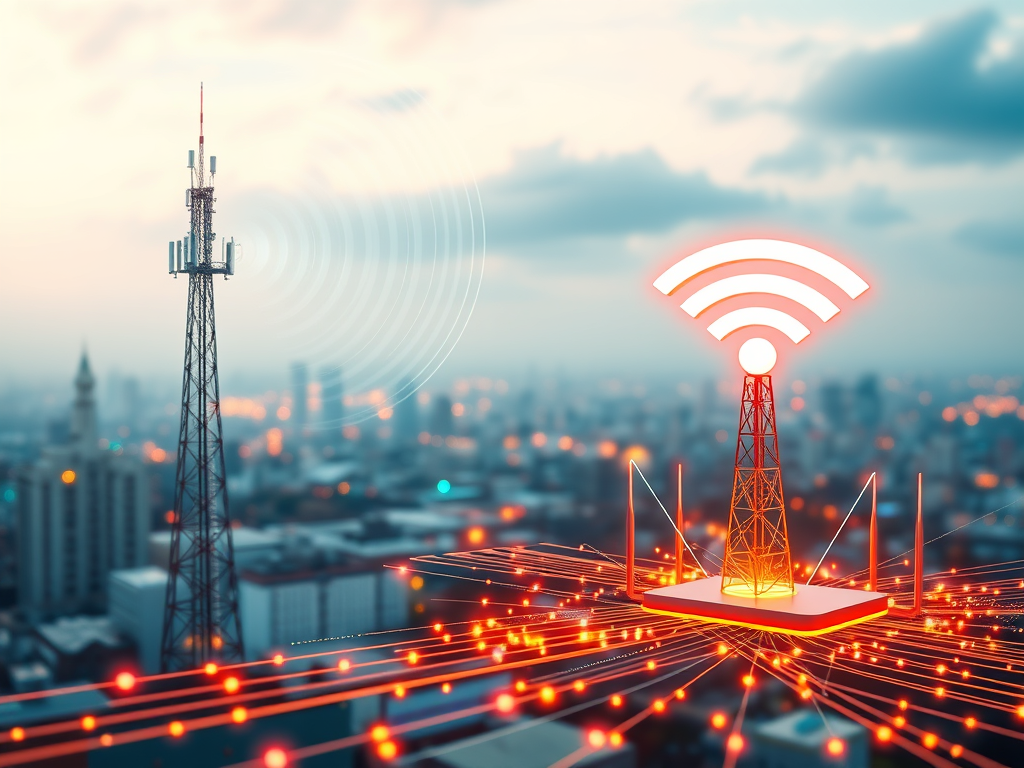
Exploring Real-World Examples of OFDM Applications
Orthogonal Frequency Division Multiplexing (OFDM) has become one of the most pivotal technologies in modern communication systems. Known for its capacity to handle high data rates and resist interference, it is the backbone of many of today’s wireless and wired communication standards. This article explores several real-world examples of how OFDM is applied, illustrating its essential role in ensuring reliable connectivity and high-speed data transmission.
One of the most prominent examples of OFDM application is in 4G LTE (Long-Term Evolution) networks. LTE uses OFDM to divide the available bandwidth into many narrowband carriers, allowing simultaneous transmission of data streams and improving spectral efficiency. As a result, users experience faster download speeds and reduced latency. This efficiency has allowed mobile communication providers to deliver smoother video streaming, clearer calls, and enhanced connectivity even in high-traffic areas.
Another key implementation of OFDM is in Wi-Fi technology, specifically in standards like IEEE 802.11a/g/n/ac/ax. Wi-Fi employs OFDM to enhance performance in multipath environments—areas where signals are reflected off surfaces, such as walls or furniture. By breaking the data into multiple subcarriers, Wi-Fi networks ensure that users maintain stable and reliable connections, whether in a home, office, or public place. For instance, IEEE 802.11ax (Wi-Fi 6) uses OFDMA (a multi-user version of OFDM) to support multiple users simultaneously without interference.
Key Takeaways:
- OFDM enhances data transmission reliability even in challenging environments.
- Technologies such as 4G LTE and Wi-Fi owe much of their performance to OFDM’s structure.
- The distribution of data among multiple subcarriers mitigates the effects of signal fading and interference.
Case Studies Highlighting the Impact of OFDM Technology
A practical case study can be found in the deployment of 5G networks, which extend OFDM principles even further. According to reports by the 3rd Generation Partnership Project (3GPP), 5G New Radio (NR) utilizes flexible subcarrier spacing and scalable numerology, both made possible by OFDM. This flexibility allows 5G networks to cater to vastly different scenarios—from low-latency applications like autonomous vehicles to high-throughput needs such as augmented and virtual reality. With speeds up to 10 Gbps and latency as low as 1 ms, OFDM enables a foundation for the next generation of global connectivity.
Another example appears in Digital Video Broadcasting (DVB-T2), a standard for terrestrial television broadcasts. According to DVB.org, OFDM provides robustness against multipath propagation and interference, critical for maintaining clear television signals in urban environments. This ensures viewers receive high-definition broadcasts even when signals travel through complex paths or over long distances. Broadcasters have adopted this system worldwide to deliver more channels, improved image quality, and better spectrum utilization.
Similarly, Power Line Communication (PLC) represents a less conventional but equally fascinating application of OFDM. PLC systems, such as those standardized under HomePlug AV, use existing electrical wiring to transmit data. OFDM improves performance by mitigating noise from electrical appliances and interference from other devices, enabling stable home networking through the power grid. This approach allows homes and businesses to access reliable, wired-like communications even without dedicated network cabling.
Key Takeaways:
- 5G networks use OFDM to achieve ultra-fast speeds and low latency.
- DVB-T2 applies OFDM for resilient and efficient broadcast transmission.
- Power Line Communication systems exploit OFDM to turn electrical grids into communication networks.

In summary, the examples above demonstrate how OFDM has revolutionized communication in diverse fields—from mobile networks to broadcasting and home data systems. As technology continues to evolve, OFDM remains a cornerstone, enabling faster, more stable connections across the globe. Readers are encouraged to reflect on how often they engage with OFDM-driven technologies in everyday life—each Wi-Fi connection, video call, and TV broadcast is a subtle testament to its power. Understanding these applications not only highlights the ingenuity of modern engineering but also sparks appreciation for the invisible systems that keep our world connected.
Discover more from Archer IT Solutons
Subscribe to get the latest posts sent to your email.


No responses yet