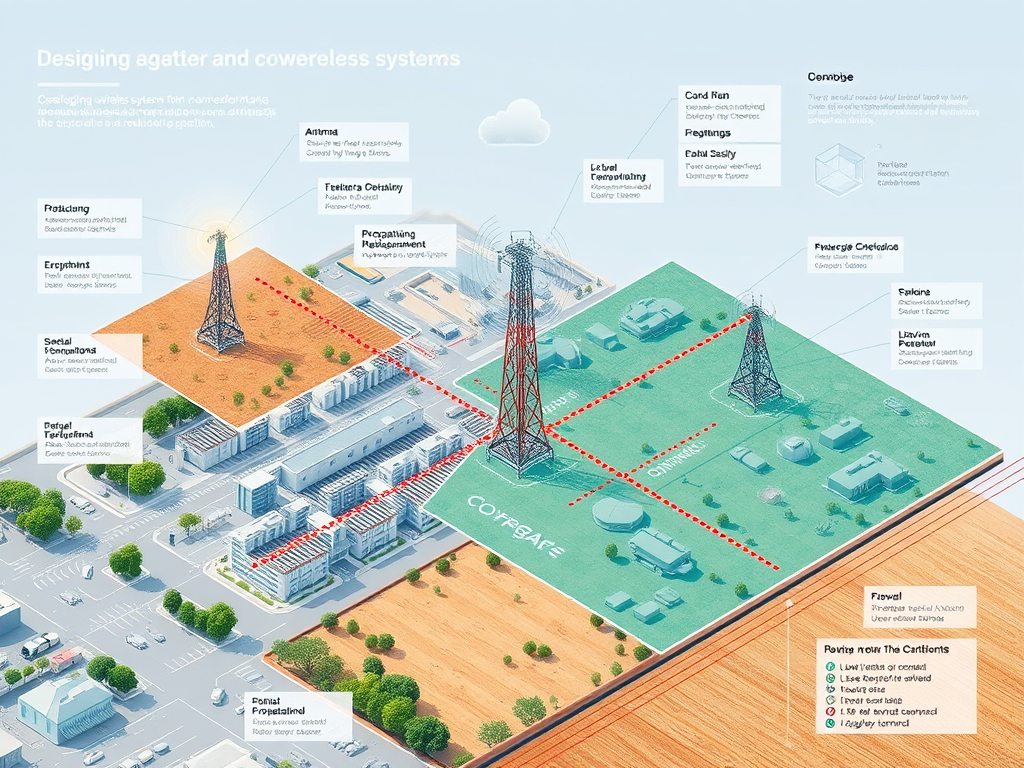
Designing a wireless communication system involves much more than choosing the latest hardware or setting up antennas in strategic places. It’s a complex process influenced by environmental, technical, and operational factors that determine how effectively the system delivers consistent, reliable connectivity. From signal propagation to user density and bandwidth limitations, the design decisions made early on can make or break a wireless network’s success.
In this article, we’ll explore the key factors that affect wireless system design and examine real-world examples of successful implementations. By understanding the nuances of these factors, both professionals and enthusiasts can better appreciate what it takes to create robust, future-ready wireless systems.
Key Environmental and Technical Factors in Wireless Design
The design of a wireless system is heavily influenced by environmental conditions. Factors such as terrain, building materials, and atmospheric conditions can greatly impact signal propagation. For example, urban environments with dense buildings can create multipath reflections, causing signal interference or degradation. Meanwhile, rural or open areas may face coverage challenges due to distance and limited line-of-sight connectivity. Consequently, designers must incorporate path loss modeling and perform site surveys to ensure optimal placement of antennas.
Technical factors also play a significant role. Key aspects include frequency selection, bandwidth management, and power control. Different frequency bands (e.g., 2.4 GHz vs. 5 GHz for Wi-Fi) offer varied trade-offs between speed, coverage, and interference resistance. Moreover, power efficiency and antenna gain are critical considerations, especially in IoT systems where energy constraints are paramount. Advanced technologies such as MIMO (Multiple Input Multiple Output) and beamforming further enhance reliability and data throughput.
Furthermore, regulatory and standard-related constraints affect design freedom. Networks must comply with regional spectrum regulations laid out by organizations like the Federal Communications Commission (FCC) or International Telecommunication Union (ITU). Designers must ensure that frequency allocations align with permitted usage while maintaining adequate security protocols such as WPA3 or SSL for encrypted transmissions.
Key takeaways:
- Environmental features dictate signal performance and coverage efficiency.
- Technical design choices like frequency and power allocation determine capacity.
- Compliance with regulations ensures safety, interoperability, and reliability.

Case Studies Illustrating Real-World Wireless System Success
One real-world example is the City of Barcelona’s Smart City Wi-Fi initiative. The city deployed over 500 public access points, ensuring connectivity across parks, transport hubs, and tourist areas. Designers had to adapt to mixed urban terrain and seasonal density fluctuations. By integrating mesh networking and adjusting coverage zones dynamically, the city achieved over 95% network uptime, providing valuable lessons on scalability and adaptive network planning.
In another case, NASA’s Jet Propulsion Laboratory (JPL) optimized its wireless telemetry systems for rover communication using advanced signal modulation techniques. The Martian environment presented severe propagation challenges — dust, topography, and latency constraints. Engineers applied adaptive modulation based on varying signal strength, enabling consistent data transmission across millions of kilometers. This demonstrates how environmental modeling and technical innovation combine to achieve mission-critical reliability.
Corporate campuses also offer compelling case studies. For instance, Google’s corporate Wi-Fi infrastructure integrates AI-based network optimization using traffic prediction and real-time interference detection. The result is a system capable of maintaining near-zero latency during high-density periods while reducing bandwidth waste by approximately 15%. Such implementations show how big data and intelligent algorithms can enhance user experience.
Key takeaways:
- Adaptive designs ensure resilience in challenging or fluctuating environments.
- Case studies highlight how diverse factors—from terrain to traffic—impact outcomes.
- Predictive and AI-driven management can significantly boost system efficiency.

Wireless system design is a balancing act — one that involves harmonizing environmental realities, technical possibilities, and user expectations. By studying the principles and real-world examples discussed above, designers can gain valuable insights into what truly makes a wireless network dependable and scalable. Whether it’s a smart city, a corporate campus, or an interplanetary mission, the fundamentals remain the same: adaptability, precision, and innovation.
As you think about your own wireless needs — whether for a home, a business, or a larger infrastructure project — consider how each factor fits into your environment. Reflecting on your unique design context can help you choose the best technologies and strategies to maintain both performance and sustainability in the long term.
For further reading:
- IEEE Wireless Communication Standards Overview
- ITU Radiocommunication Sector Guidelines
- NASA Communications and Navigation Program
Discover more from Archer IT Solutons
Subscribe to get the latest posts sent to your email.


No responses yet