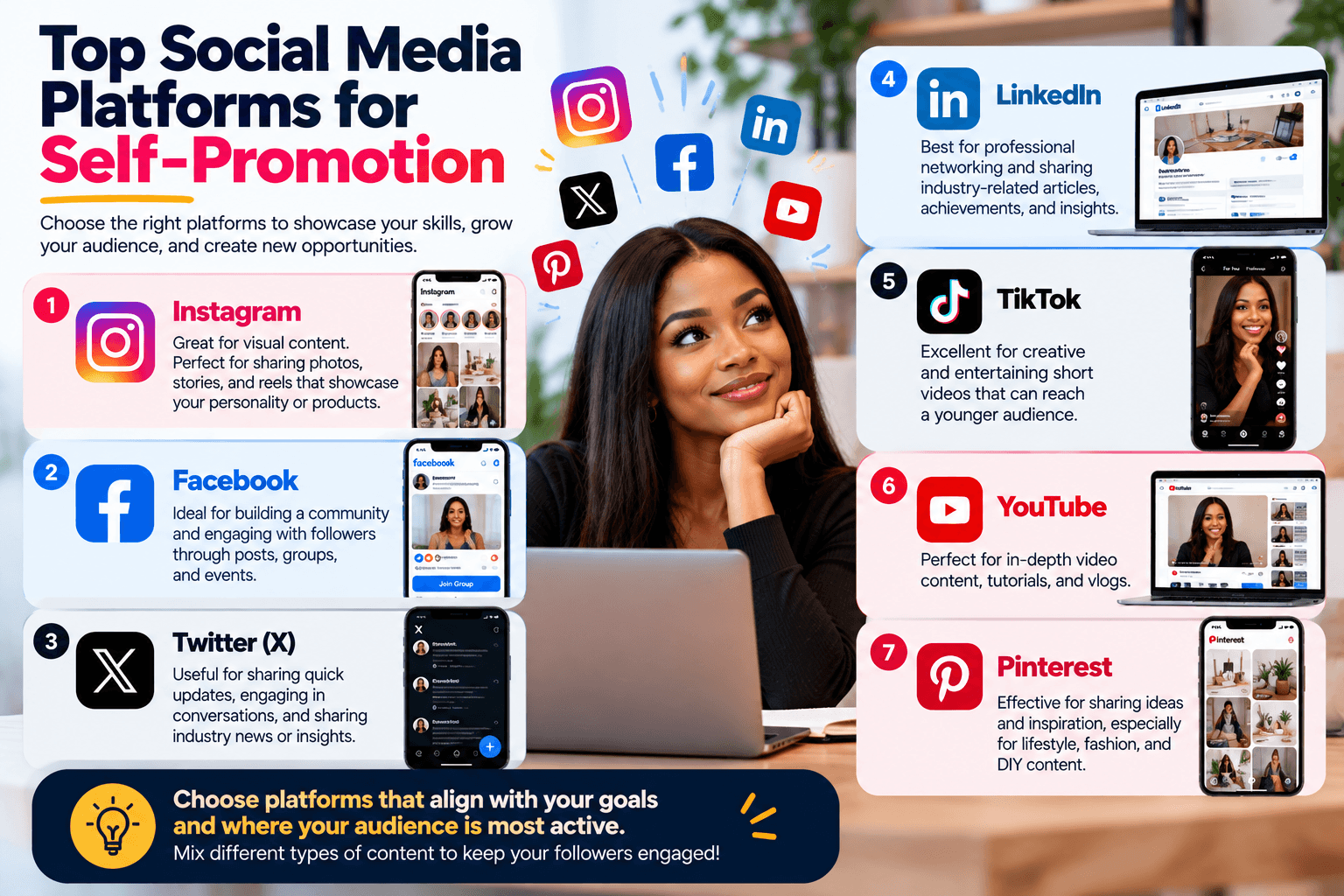
Top Social Media Platforms for Self-Promotion
Social media can help individuals, businesses, and creators increase visibility, demonstrate expertise, build relationships, and direct people toward their websites or other online channels.
However, being active on every platform is not necessarily the best strategy. The right platform depends on who you want to reach, what type of content you create, and what you want your self-promotion to achieve.
Before choosing your platforms, consider where your audience already spends time and which formats you can consistently create.
1. Instagram
Instagram is particularly useful for visual self-promotion. Photos, Reels, Stories, carousels, and other visual formats can help creators, professionals, and businesses showcase their work, products, personality, or expertise.
Instagram can work well for:
- Personal branding
- Product promotion
- Visual portfolios
- Behind-the-scenes content
- Short educational videos
- Lifestyle and creative content
If your website is an important part of your online presence, social media can also direct interested followers to your website, service pages, portfolio, or contact page.
2. Facebook
Facebook can be useful for building communities and maintaining relationships with an established audience.
Businesses and individuals can use Facebook for:
- Business updates
- Community discussions
- Groups
- Events
- Educational content
- Customer engagement
- Links to website content
Facebook can be particularly useful when your audience values ongoing conversations rather than only short-form content.
3. X (formerly Twitter)
X can be useful for sharing short updates, participating in industry conversations, commenting on current topics, and connecting with people in a particular field.
It can work well for professionals who want to:
- Share industry insights
- Comment on current developments
- Participate in conversations
- Share articles and resources
- Build relationships with other professionals
- Establish a recognizable professional voice
The platform is now called X, although many people still refer to it as Twitter.
4. LinkedIn
LinkedIn is one of the strongest options for professional self-promotion and B2B networking.
Professionals can use LinkedIn to share:
- Industry knowledge
- Career achievements
- Professional experiences
- Articles and research
- Project results
- Business updates
- Practical advice
For service businesses, LinkedIn content can also work alongside a professional website. Your social profile can introduce people to your expertise while your website provides more detailed information about your services and capabilities.
A well-designed website can support this strategy by giving people somewhere credible to go after discovering you on social media. Archer’s web design services can be relevant for businesses looking to build or improve that online presence.
5. TikTok
TikTok is built around short-form video and can provide opportunities for creative, educational, entertaining, and personality-driven content.
You could use TikTok to share:
- Quick tutorials
- Industry tips
- Demonstrations
- Educational explanations
- Behind-the-scenes content
- Product videos
- Short personal-branding content
The platform can be especially useful when you can communicate an idea quickly through video rather than relying on long written posts.
6. YouTube
YouTube is useful when your content requires more explanation than a short social post can provide.
Potential content includes:
- Tutorials
- How-to guides
- Product demonstrations
- Interviews
- Educational videos
- Industry discussions
- Reviews
- Video presentations
YouTube also allows businesses and creators to maintain a dedicated public channel where they can organize their video content. Google Help
For example, a technology company could create videos explaining common IT problems and then direct viewers to relevant service or support pages on its website.
7. Pinterest
Pinterest can be effective for visual discovery, particularly for content related to lifestyle, fashion, design, food, home improvement, crafts, and other visually driven subjects.
Pinterest can be used to share:
- Ideas and inspiration
- Infographics
- Blog posts
- Tutorials
- Product images
- Design concepts
- Guides and checklists
Unlike platforms where content is primarily consumed through a constantly changing feed, Pinterest can also function as a discovery platform where users search for ideas and resources.
Don’t Try to Be Everywhere
One of the biggest mistakes in social media self-promotion is assuming that you need an active account on every platform.
Instead, choose two or three platforms that best match your audience and content strengths.
For example:
| Goal | Platforms to Consider |
|---|---|
| Professional networking | |
| Visual personal branding | |
| Short-form video | TikTok |
| Long-form video | YouTube |
| Community building | |
| Industry conversations | X |
| Visual discovery |
The goal is not simply to accumulate followers. Your content should help the right people discover you, understand what you offer, and take a useful next step.
Connect Social Media With Your Website
Social media and your website should work together rather than operate as completely separate channels.
Your social profiles can attract attention, while your website can provide the deeper information visitors need to make a decision.
For example:
Social media post → Website article → Service page → Contact or inquiry
Your website could contain:
- Detailed service information
- Portfolio or project examples
- Blog articles
- Product information
- Contact forms
- Booking options
- Downloadable resources
Archer IT Solutions has also published guidance on social media integration for websites, including ways to connect platforms such as Facebook, Instagram, LinkedIn, X, and YouTube with a website. Archer IT Solutions
Create Content That Gives People a Reason to Follow You
Self-promotion does not mean talking about yourself in every post.
Instead of repeatedly saying:
“Hire me.”
show people why they should consider you.
You can demonstrate your expertise through:
- Helpful tips
- Case studies
- Tutorials
- Lessons learned
- Industry observations
- Before-and-after examples
- Educational content
- Answers to common questions
- Behind-the-scenes processes
This makes your content more useful while still building awareness of your skills, products, or services.
Your website can serve as the deeper resource behind this content. A strong website structure and clear content can make it easier for visitors who discover you on social media to continue exploring your brand. Archer IT Solutions
Choose Platforms Based on Your Audience
There is no universally “best” social media platform for self-promotion.
A professional consultant may get more value from LinkedIn, while a fashion creator may benefit more from Instagram, TikTok, and Pinterest. A technical educator may find YouTube particularly useful for explaining complicated subjects.
Start by asking:
- Who am I trying to reach?
- What type of content can I create consistently?
- What platform does my audience actually use?
- What action do I want people to take?
- Can I maintain the account without spreading myself too thin?
Once you have answers to these questions, choose the platforms that best support your goals.
Final Thoughts
The best social media platform for self-promotion is not necessarily the one with the largest audience. It is the platform where your target audience is active, your content fits naturally, and you can consistently provide value.
Instagram can be strong for visual branding, Facebook for communities, X for conversations, LinkedIn for professional networking, TikTok for short-form video, YouTube for deeper educational content, and Pinterest for visual discovery.
Rather than trying to master all seven at once, start with the platforms that align most closely with your audience and objectives. Then use your website as the central place where interested people can learn more about you, your expertise, products, or services.
[submit “Submit”]
1
[_site_title] “[your-subject]”
[_site_title]
[_site_admin_email]
From: [your-name] [your-email]
Subject: [your-subject]
Message Body:
[your-message]
—
This is a notification that a contact form was submitted on your website ([_site_title] [_site_url]).
Reply-To: [your-email]
1
1
[_site_title] “[your-subject]”
[_site_title]
[your-email]
Message Body:
[your-message]
—
This email is a receipt for your contact form submission on our website ([_site_title] [_site_url]) in which your email address was used. If that was not you, please ignore this message.
Reply-To: [_site_admin_email]
1
1
Thank you for your message. It has been sent.
There was an error trying to send your message. Please try again later.
One or more fields have an error. Please check and try again.
There was an error trying to send your message. Please try again later.
You must accept the terms and conditions before sending your message.
Please fill out this field.
This field has a too long input.
This field has a too short input.
There was an unknown error uploading the file.
You are not allowed to upload files of this type.
The uploaded file is too large.
There was an error uploading the file.
Please enter an email address.
Please enter a URL.
Please enter a telephone number.
Please enter a date in YYYY-MM-DD format.
This field has a too early date.
This field has a too late date.
Please enter a number.
This field has a too small number.
This field has a too large number.
The answer to the quiz is incorrect.


No responses yet